Alaska Airlines is going global, but can Seattle support it? We break down the load factors, hub strategy, and what’s at stake for their international network.
Alaska Airlines’ first Boeing 787 Dreamliner flight from Seattle to Rome kicked off last week. It gained a lot of fan fare on FlightRadar24’s Instagram. That kind of consumer excitement signals something real. Alaska is no longer a regional carrier playing West Coast-only operations.
Since their acquisition of Hawaiian Airlines, the airline has expanded to Europe and international destinations throughout Asia, transforming from a West Coast-only operation into something that looks increasingly like a national and international player.
But here’s a question…is the foundation they’ve built strong enough to support their international ambitions?
Let’s analyze the case for and against that notion.
Understanding Alaska’s West Coast-First Strategy
Alaska’s hub structure tells you everything about their operational strategy. Their hubs are concentrated entirely on the West Coast: Seattle, Anchorage, San Francisco, Los Angeles, Portland, and San Diego.
Airport
Alaska’s Market Share %
Next Largest Carrier Market Share
Seattle
47.85%
Delta – 19.49%
Anchorage
61.89%
Delta – 13.57%
Portland
32.5%
Southwest – 13.28%
Seattle is without a doubt their super hub, where the bulk of their high-yield route pairs and international flying originates. Their California hubs focus primarily on Hawaii flying, leisure flights down to Mexico and with some transcons sprinkled in.
Their reliance on San Francisco and Los Angeles has slightly begun to diminish, as those airports are notably difficult to remain competitive in, relatively speaking against United and Delta. More recently, Alaska has been growing operations at nearby San Diego instead. But ultimately, the goal of these California hubs is to help flow more customers towards Seattle.
Alaska is one of the only airlines to geographically isolate their hubs to a single coast. Delta, United, and American have a presence in major cities throughout the United States. Southwest and Frontier, despite not officially labeling their core cities as hubs, maintain a footprint at large airports across the country.
The only relatively large airline that mirrors this strategy is JetBlue. They’ve largely scaled back their West Coast presence when they dropped Long Beach in favor of Los Angeles. But now primarily focus much of their flying on the East Coast, like when they first started.
JetBlue is navigating their own issues of mixed brand identity, caught between East Coast flying, low-yield Latin American routes, and transatlantic ambitions. While the geographic concentration strategy is similar to both airlines, Alaska is executing the strategy considerably better. JetBlue, by contrast, is reportedly on the brink of bankruptcy partially due to their own brand confusion.
Airline
Hubs
East Coast
Midwest
West Coast
Alaska Airlines
ANC,LAX,PDX,SAN,SFO,SEA
0
0
6
American Airlines
CLT,ORD,DFW,LAX,MIA,LGA,PHL,PHX,DCA
5
2
2
Delta Air Lines
ATL,BOS,DET,LAX,MSP,JFK,LGA,SLC,SEA
4
2
3
United Airlines
ORD,DEN,IAH,LAX,EWR,SFO,IAD
2
2
3
Frontier Airlines
ATL,DEN,PHL,LAS,DFW,MCO
3
1
2
JetBlue Airways
BOS,FLL,JFK,MCO
4
0
0
Southwest Airlines
MDW, BWI, DAL, LAS, BNA, PHX, MCO, SAN, DEN
3
2
4
Allegiant Air
LAS, AZA, SFB,
1
0
2
Sun Country Airlines
MSP
0
1
0
This West Coast only strategy has been working for Alaska for a long time. But the core question of this analysis is whether that geographic isolation is leaving revenue or potential customers on the table, specifically when it comes to their overseas intercontinental operation.
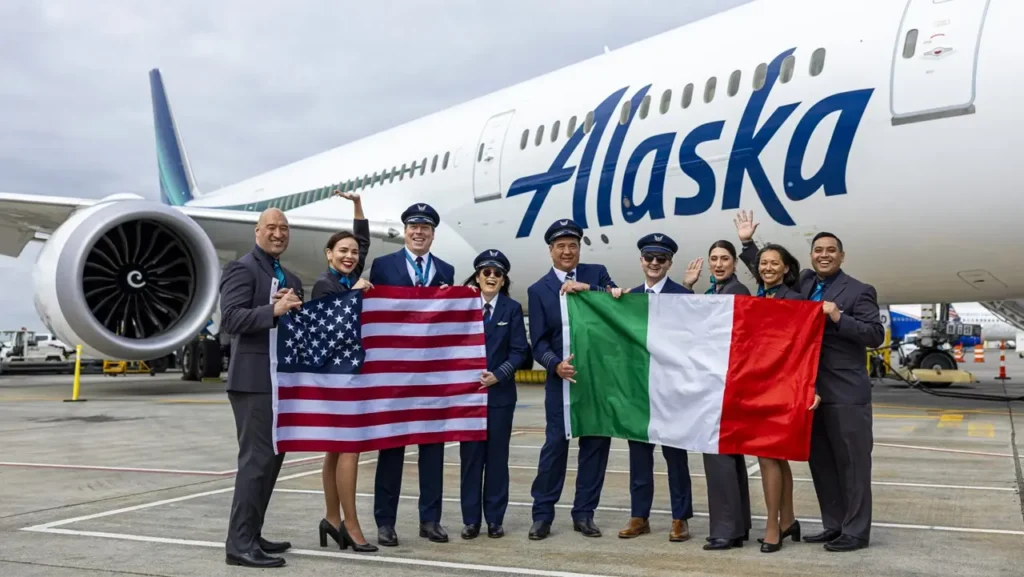
Alaska Airlines flight crew from their first flight to Rome.
Why The West Coast Only Strategy Actually Works In Alaska’s Favor
One of the main benefits of building a network around Seattle is that virtually every high yield connecting flight into SEA is a lengthy flight. That distance alone creates a natural opportunity to market premium cabin arrangements and convert passengers into Mileage Plan members. That recurring loyalty income matters a lot especially in today’s airline market.
Those premium loyalty miles earned on transcontinental flying feed directly into Alaska’s international product. Loyal Alaska customers accumulate points on those long domestic legs, and suddenly a trip to Rome using Alaska doesn’t seem like a stretch. Miles can lead to perks or shave a few dollars off the fare. International routes depend heavily on premium cabin revenue to stay profitable, and Alaska’s domestic network is quietly building the customer base that sustains it.
The Problem With Seattle As An International Foundation
Seattle, for all its strengths as Alaska’s fortress, has a geography problem. It sits in the Pacific Northwest and it is not Los Angeles, and it is not Chicago. The local population base it draws from is significantly smaller than the mega-hubs Delta and United operate from.
City
2020 Census Population
Tourists visited
Seattle
737,015
39.6 million (2025)
Los Angeles
3,898,747
49.1 million (2023)
Chicago
2,746,388
55 million (2025)
New York City
8,804,190
65 Million (2025)
Pacific Northwest residents will naturally funnel through Seattle using Alaska out of convenience. But outside that region, West Coast travelers tend to gravitate toward LAX, SFO, or even Phoenix for their international connections. Alaska knows this, which is why Seattle relies heavily on connecting traffic to feed its operation.
On a more national scale, you’re asking loyal Alaska Airline travelers from Boston, Atlanta, or Chicago to connect through Seattle to reach a destination they could access more directly on Delta from JFK or United from O’Hare. The inconvenience compounds, and Alaska’s price advantage or premium perk package has to work harder to compensate. No customer in their right mind wants to double-back just for the fun of it.
However, it appears that Alaska has already solved the international flight dilemma for their East Coast travelers.
What Alaska Has Going For It
Alaska’s Oneworld membership provides a partner network at key East Coast international gateways. Most notably JFK, where Alaska has gone as far as building an Atmos lounge despite operating only a handful of their own flights there.
They’re leaning on Oneworld partners who already have a robust schedule from that airport rather than competing for gates directly or committing their own aircraft on routes. Given how expensive and difficult gate access is at major East Coast airports, it’s a smart allocation of resources.
Alaska’s international product itself has also taken a meaningful step forward. The new cabin experience on the 787 Dreamliner, combined with the Airbus A330s inherited from Hawaiian Airlines, gives Alaska a competitive widebody product they simply didn’t have ever before.
A baseline Dreamliner delivers an experience that is genuinely comparable to what United, American, or Delta offer on similar long-haul routes.
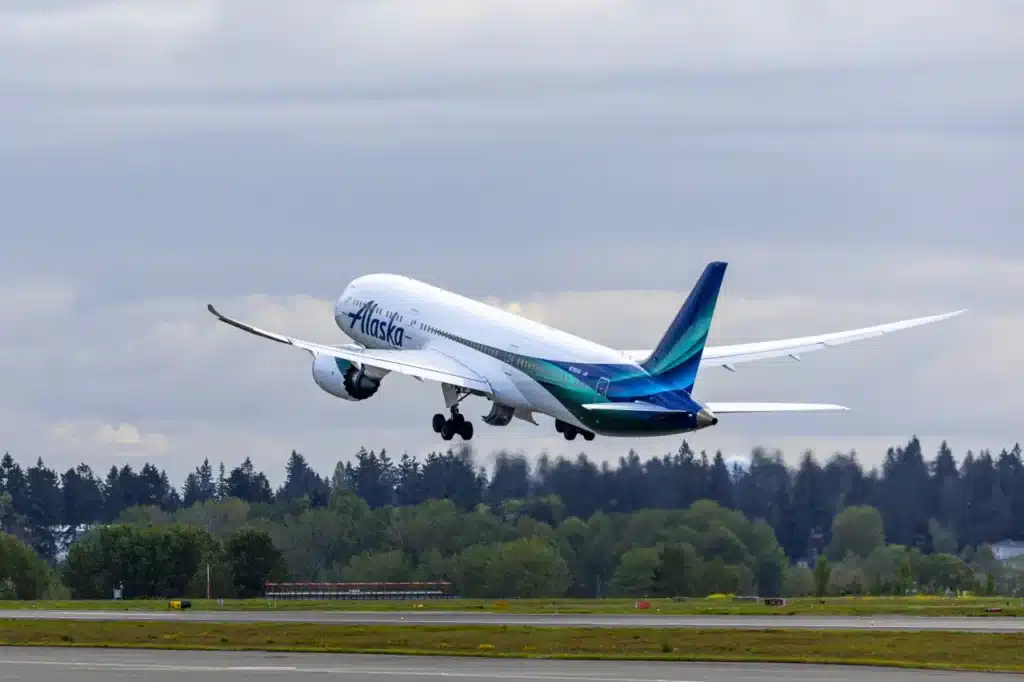
Alaska’s Boeing 787 Dreamliner taking off for Rome.
Alaska’s Asia International Rollout Is Interesting
While much of this analysis has focused on the challenges of flying eastward toward Europe, Alaska’s Pacific routes deserve their own attention, because the data is encouraging.
It’s long been known that United and Delta both dominate transoceanic flights from the United States. American simply doesn’t offer the volume of Asia service that either carrier does, leaving a meaningful gap in the market. Alaska has a real opportunity to step into that space.
Based on BTS data, Alaska is holding their own.
Airline
Route
Departures
Seats
Passengers
Load Factor
Alaska
SEA – NRT
62
18358
12832
69.8%
Alaska
SEA – ICN
46
13900
8571
62.1%
Delta
SEA – ICN
64
18961
13428
70.8%
United
SFO – NRT
62
17369
13245
76.2%
Alaska’s cornerstone routes between Seattle, Tokyo, and Seoul are performing on par with what Delta and United are currently running on directly comparable flights. The passenger counts, seat capacity, and load factors are competitive. That’s not a small thing for an airline that is still relatively new to this space.
Europe still presents more questions than answers due to the sheer fact that the service just started. The Rome launch is exciting, but it’s one route. But there’s more coming. Iceland and London are starting up in a few days.
Alaska’s Pacific operation already has some legs to it. Which is great for Alaska Airlines to be confident about when it comes to their international product.
Final Thoughts on Alaska’s Strategy
For now, their West Coast strategy remains the clearest path forward for their international service.
Alaska has the product. The honest question is whether Seattle’s metropolitan area, even with robust connecting traffic, can generate the demand needed to scale their international network the way the airline clearly intends to. Which it likely can, evidenced by their success in the Asia market so far.
But Delta isn’t standing still in Seattle. Southwest has moved into Anchorage. The competitive pressure on Alaska’s home turf is real and arriving from multiple directions simultaneously.
The Rome launch is an exciting opening move. But one flight being hyped on FlightRadar24 tells you about enthusiasm, not load factors. That’s the number worth watching.
Andrew McMenamy
Founder of Your Weekend Travel.
Andrew always had a passion for aviation, travel, and history since he was a kid. Today, he is applying his professional knowledge of digital marketing with his passion, making content related to travel, aviation, and much more.
Sign Up to Get New Content Delivered To Your Inbox!
By signing up, you agree to receive newsletters and promotional content and acknowledge the data practices in our privacy policy. You may unsubscribe at any time.
Eurowings Discover offers flights to and from Germany in leisure markets in North America, Central America, and Africa on board it's Airbus A330 aircraft. By the end of this guide,…
Spirit Airlines for the second time in almost a year announces it'll go into bankruptcy protection. The airline said day to day operations will not be affected.
British Airways announced as part of it's strategy to increase flights to U.S vacation destinations, a new direct route between St. Louis and London - Heathrow.
Sign Up to Get New Content Delivered To Your Inbox!
By signing up, you agree to receive newsletters and promotional content and acknowledge the data practices in our privacy policy. You may unsubscribe at any time.
If you found this article helpful please consider marking Your Weekend Travel as a preferred source on Google!
Delta's A321-200s are used on the airline's short to medium-domestic routes. In this guide, we let you know which routes the Delta uses the A321 and more.
PLAY Airlines started flying between the U.S and Iceland in Summer of 2022. Today, they fly from three U.S cities. Learn more about PLAY U.S - Iceland service.
American Airlines will be restarting its Sarasota - Miami route pairing in November 2025 after a 16 year break. It'll help bolster it's strategy in Miami.
Allegiant Air is an ultra-low-cost air carrier found in the United States. Find out everything you need to know about its aircraft and the routes they fly.
Sign Up to Get New Content Delivered To Your Inbox
By signing up, you agree to receive newsletters and promotional content and acknowledge the data practices in our privacy policy. You may unsubscribe at any time.