Southwest Is Aiming Hard on Premium. But Still Missing The Mark.
Andrew McMenamy
April 24th, 2026
Last Updated: April 24, 2026 8:34 am
airlinessouthwest airlines
Airline RoutesLow Cost Airlines
Southwest is adding airport lounges, but are they in the right cities? We break down why the location strategy may be missing the mark on premium travel.
Southwest Airlines is changing. By their own CEO’s admission, the airline is laser-focused on one thing and that’s stopping customers from choosing the competition. Leadership has recognized what the rest of the industry already knew. Travelers want more quality for their airfare dollar, and that’s where the real revenue lives.
To get there, Southwest has pushed out brand-altering product changes over the past year. Customer reaction has been rocky, and the true verdict comes when the airline posts its Q1 2026 earnings. But even before that drops, Southwest has unveiled its next roadmap item. Airline lounges.
Southwest wants lounges and already have an idea of airports they’re targeting. On paper, it sounds like progress. In practice, there’s reason to be skeptical as to whether they can generate juice from this proverbial fruit.
The core idea isn’t earth shattering. Lounges signal quality. Every legacy carrier has one. Even JetBlue and Alaska Airlines each have lounge space. If Southwest wants to play in the premium sandbox, lounges are a necessary next step.
Southwest has also signaled that they hope these lounges become the anchor of a stronger frequent flyer ecosystem. Airport lounge access is one of the most valued perks among frequent flyers. Southwest is hoping to roll out a product moderately comparable to Delta Sky Club or United Club.
A business traveler flying twice a week isn’t going to sit at the gate with the rest of the crowd if they don’t have to. Exclusivity and comfort are what keep those high-value customers coming back.
That part of the strategy makes sense. The execution, however, is where things start to fall apart.
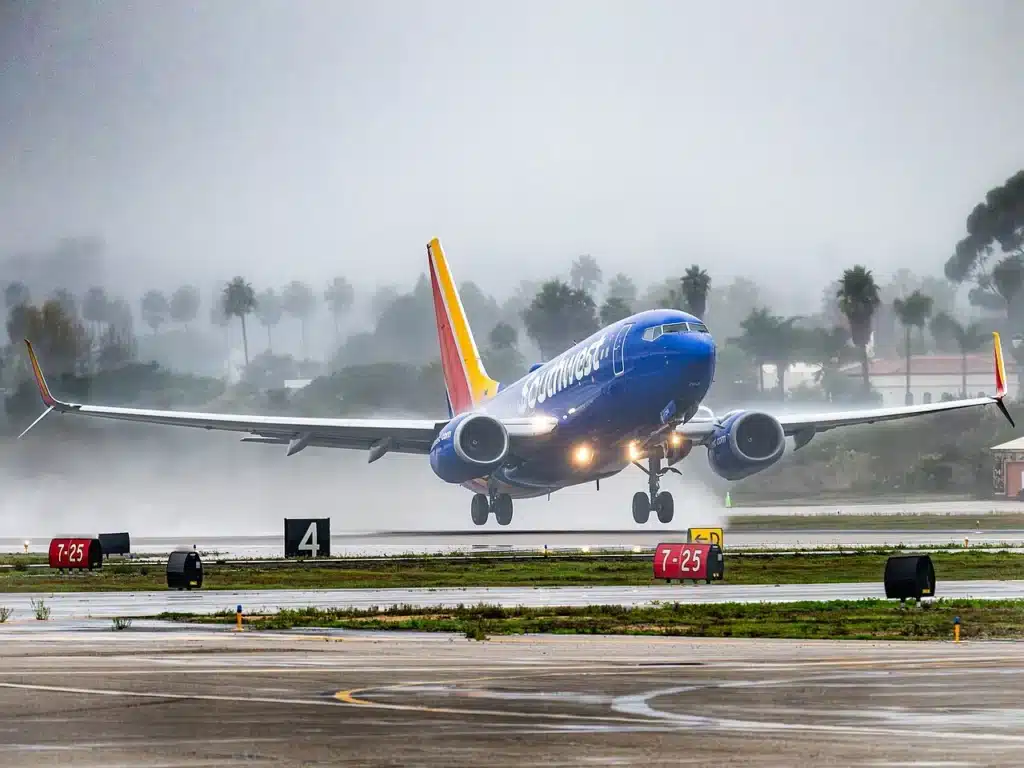
Southwest Airlines Boeing 737 MAX performing a rainy takeoff.
The Location Problem
Some of the airports in consideration by Southwest for its first lounge rollout are questionable.
Honolulu and Nashville are predominantly leisure markets. Southwest does have a meaningful presence at both airports, but these are vacation destinations, not business corridors.
Unless Southwest is specifically targeting the well-heeled retiree crowd (travelers with the time and disposable income to vacation frequently) there simply isn’t the premium business throughput needed to justify a high-end lounge at these airports.
Now, Dallas Love Field, Austin, and Denver do have a reasonable business case. Austin is an up-and-coming business city. Denver serves as Southwest’s number one airport in terms of passengers and departures, and acts as a direct counter to United’s hub dominance there. Love Field sits in the heart of Dallas with no existing airline lounge competition. Those three make sense.
But compare the full picture to where Southwest actually moves the most passengers: Chicago Midway and Baltimore/Washington. These are Southwest’s major passenger hubs sitting in or near genuine business centers, where the travelers who would realistically use a premium lounge are flying every week. And critically, neither airport has an existing airline lounge. The barriers to entry are essentially non-existent. Yet it appears they’re not making the first cut.
Departure City
Number of Departures in 2025
Number of Passengers Served in 2025
Airlines With Existing Lounges
Austin
38164
4,453,866
AA,DL, UA
Honolulu
12758
1,485,779
HA/AS, UA, DL
Denver
91659
11,786,261
AA,DL, UA
Nashville
57359
6,972,729
AA, DL
Dallas – Love
69423
8,026,051
None
Baltimore
74500
8,832,342
None
Chicago Midway
68771
8,528,421
None
Most likely, lounges will eventually reach Midway and Baltimore. But by the time they get there, customer perception will already be shaped, and first impressions in the premium space are hard to walk back.
Will Lounges Affect Southwest Operationally?
It also gets puzzling from an operational standpoint. Southwest built its reputation on the 45-minute turn. The airline gets people through airports fast. A premium lounge experience is predicated on passengers actually having time to use it, time to settle in, eat something, decompress. That’s the value proposition at JFK, LAX, or SFO, where international connections, long security queues, and extended layovers create genuine dwell time.
The question is whether Southwest customers at these leisure-focused airports will sacrifice making timely connections just to take advantage of a lounge.
The Marketing Gap Is the Real Problem
Southwest’s premium pivot isn’t just a product challenge. It’s a marketing one, and right now, marketing is a significant soft spot for the airline.
For years, Southwest built an audience that genuinely loved what the airline was: no-frills, hospitable, and affordable. That brand identity was powerful. “You are now free to move about the country” wasn’t just a tagline. It was a promise, and Southwest delivered on it consistently.
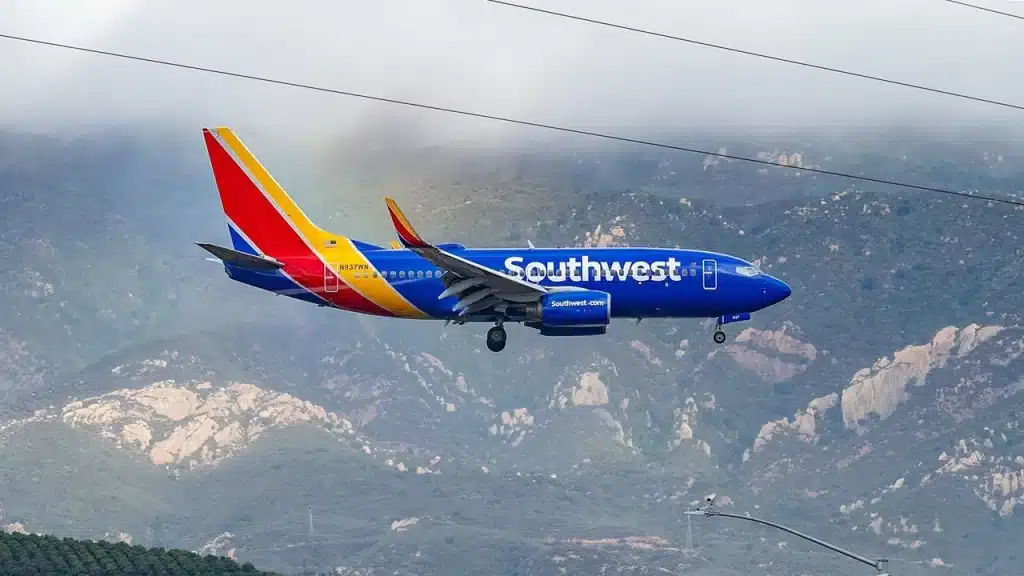
Southwest Airlines Boeing 737 landing in Santa Barbara.
Delta and United have clear, well-funded marketing machines that communicate exactly what they are. They are premium carriers that move you comfortably from point A to point B.
Southwest by contrast, is largely abandoning its old identity without successfully establishing a new one. The result is customer confusion. And when customers are confused, they fill in the blanks themselves. Right now, they’re filling them in negatively.
The numbers tell an interesting story. According to data taken from BTS and Semrush, here’s how the three airlines stacked up in 2025:
Airline
2025 Revenue
Ad Spend
Revenue Per Ad Dollar
Website Visitors (Q4 2025)
Instagram Followers
Southwest
$28.1 billion
$332 million
$84.64
116 million
1.2 million
Delta
$63 billion
$405 million
$155.56
124.5 million
1.6 million
United
$59.1 billion
$250 million
$236.40
108.2 million
1.3 million
Southwest is actually competitive with Delta and United on web traffic and social following. And notably, Southwest ranks number one among U.S. airlines in Net Promoter Score, supporting the notion that customers still think favorably about the airline.
But when it comes to revenue generated per advertising dollar, Southwest significantly trails both legacy carriers, particularly United, which spends less and converts far more efficiently.
That gap tells you the problem isn’t awareness. It’s messaging. Southwest has the audience. They’re just not converting them.
With a high NPS but weak advertising returns, and a premium push that its core customers didn’t ask for, the airline is caught in a difficult middle ground. But the airline’s solution to this problem is doubling down on premium and adding airport lounges.
How Southwest Can Salvage Their Messaging?
What Southwest should be communicating is straightforward. Premium cabins aren’t just a luxury add-on. They subsidize the back of the plane. More premium revenue means the airline can offer more competitive economy fares. Case in point is Delta, whose premium revenue surpassed revenue generated from economy in 2025.
Assigned seating and an improved boarding process means faster gate departures and more on-time arrivals. These are tangible, relatable benefits for the average traveler, but only if someone actually explains them.
Southwest has the ingredients for a compelling story. They’re just not telling it, letting their customers control the perception.
Will Any of This Actually Keep Customers?
Airport lounges as a standalone move aren’t enough to significantly shift the needle for Southwest.
Southwest’s point-to-point network doesn’t serve the high-yield business routes where airlines generate their largest margins. Frequent business flyers wanting a true premium cabin experience will book Delta One, United Polaris, or even JetBlue Mint before they consider Southwest.
And the families who historically made up Southwest’s core? They’re not the lounge demographic.
Also, why would a business executive trying to get work done before a flight want to share a lounge with a family of four and two screaming kids?
Southwest has acknowledged that roughly 25% of their customers are business travelers who fly Southwest for the routes but defect to United or Delta for the perks. Lounges are an attempt to close that gap.
But without the right locations, the right marketing, or a truly differentiated product, these lounges risk becoming crowded, unfocused spaces that fail to impress the premium traveler while alienating the budget-conscious one.
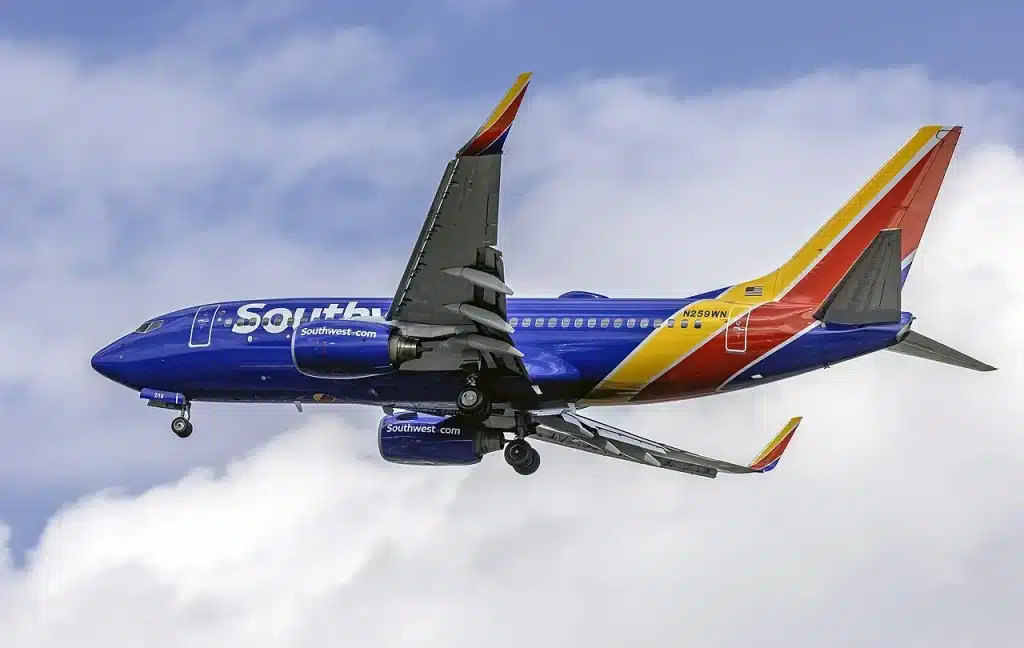
Southwest Airlines landing in Baltimore.
What Southwest Should Actually Do
Southwest’s most urgent priority should be customer retention, making frequent flying with the airline genuinely compelling again.
A well-structured co-branded credit card and a more rewarding mileage program would do far more to build loyalty than a lounge in Nashville. These are dynamic, scalable tools that benefit a broad slice of the customer base, not a fixed amenity that only a small percentage will ever use.
If Southwest stays committed to the lounge concept, the location strategy needs a serious rethink. Baltimore & Chicago Midway should of been the first two on the list. They’re airports with the some of highest passenger volume, the closest proximity to business centers, and zero lounge competition already in place.
Southwest still has the route network, the operational efficiency, and enough customer goodwill to compete. But competing doesn’t mean copying. The airline built its identity by zigging when the legacy carriers zagged. Right now, they’re zagging with everyone else and losing face in the process.
Andrew McMenamy
Founder of Your Weekend Travel.
Andrew always had a passion for aviation, travel, and history since he was a kid. Today, he is applying his professional knowledge of digital marketing with his passion, making content related to travel, aviation, and much more.
Sign Up to Get New Content Delivered To Your Inbox!
By signing up, you agree to receive newsletters and promotional content and acknowledge the data practices in our privacy policy. You may unsubscribe at any time.
Spirit Airlines for the second time in almost a year announces it'll go into bankruptcy protection. The airline said day to day operations will not be affected.
Alaska Airlines launches Seattle to Reykjavik service on the 737 MAX 8. Here's why this uncontested route may be their smartest international move yet.
Sign Up to Get New Content Delivered To Your Inbox!
By signing up, you agree to receive newsletters and promotional content and acknowledge the data practices in our privacy policy. You may unsubscribe at any time.
If you found this article helpful please consider marking Your Weekend Travel as a preferred source on Google!
Alaska Airlines is going global, but can Seattle support it? We break down the load factors, hub strategy, and what's at stake for their international network.
United Airlines is starting flights to Iceland from Washington Dulles starting in Summer 2026. The route pairing will be flown with their Boeing 757 fleet.
Sign Up to Get New Content Delivered To Your Inbox
By signing up, you agree to receive newsletters and promotional content and acknowledge the data practices in our privacy policy. You may unsubscribe at any time.