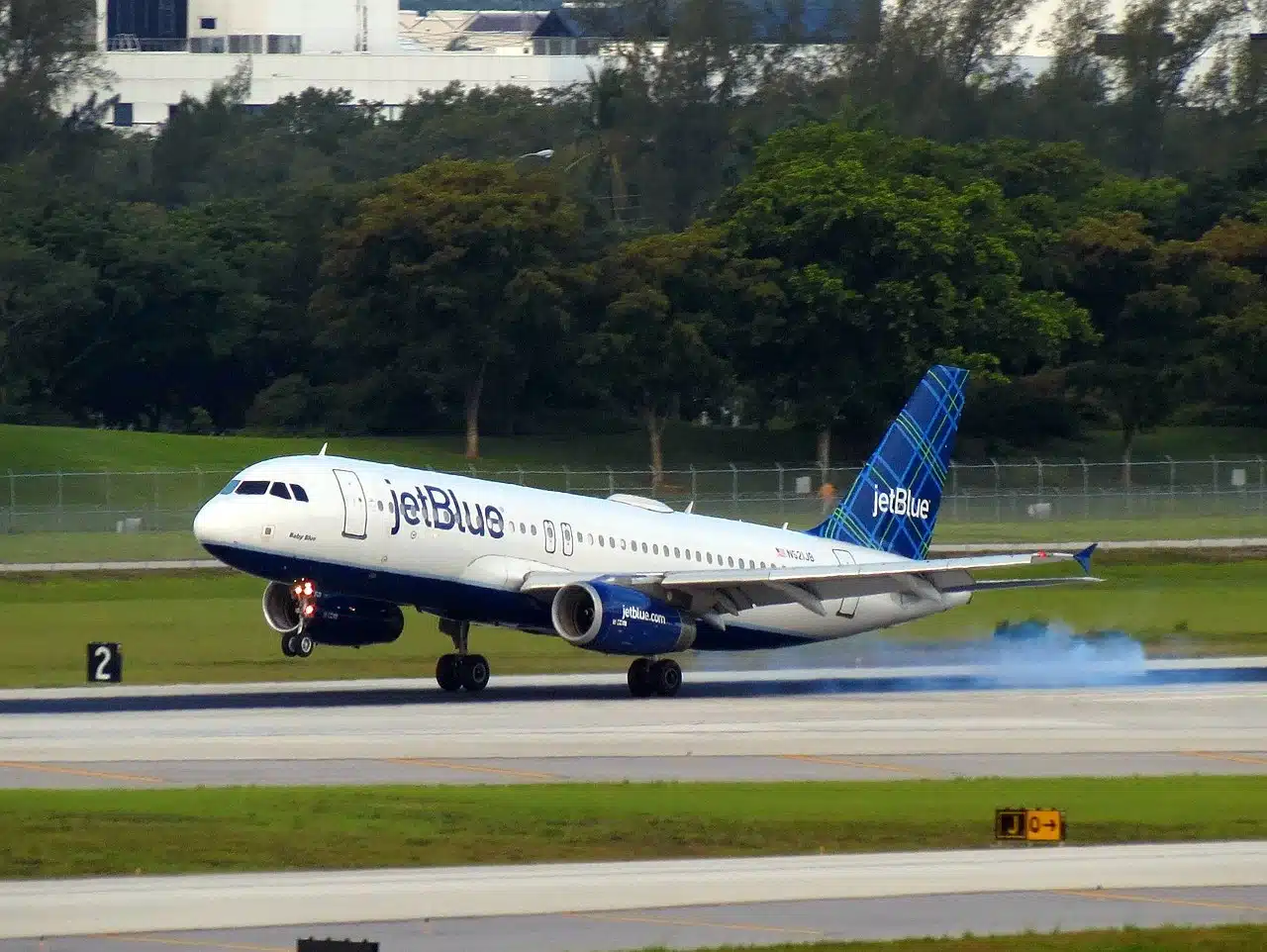
JetBlue Completes First Flight Between NYC and Bonaire
JetBlue announced launch of service between New York - JFK Airport and Bonaire's Flamingo International Airport. Learn more about this new flight offering.

Frontier Airlines is one of the most fuel-efficient carriers in the U.S. But efficiency alone won’t fix the brand problem holding them back.
The 2026 Iran War has done what Middle East conflicts tend to do. It’s made everything more expensive. With oil movement through the Strait of Hormuz disrupted, global oil supply has tightened while demand remains constant. This has resulted in jet fuel prices averaging between $4 and $5 a gallon for the first time since Russia invaded Ukraine in early 2022.
Every airline is feeling it. But not every airline is equally equipped to handle it. Right now, Spirit Airlines is rumored to liquidate due to creditors becoming uneasy about Spirit being able to pay off debts due to fuel costs.
But Frontier Airlines is built from the ground up around fuel efficiency and cost discipline. They should be among the most resilient. Let’s look at whether that holds up in the numbers.
Frontier’s entire business model is designed to minimize cost, and fuel optimization sits at the center of that strategy. The airline passes fuel savings directly to customers in the form of lower base fares. The leaner they run, the more competitive their pricing.
They pursue that efficiency through four main levers:
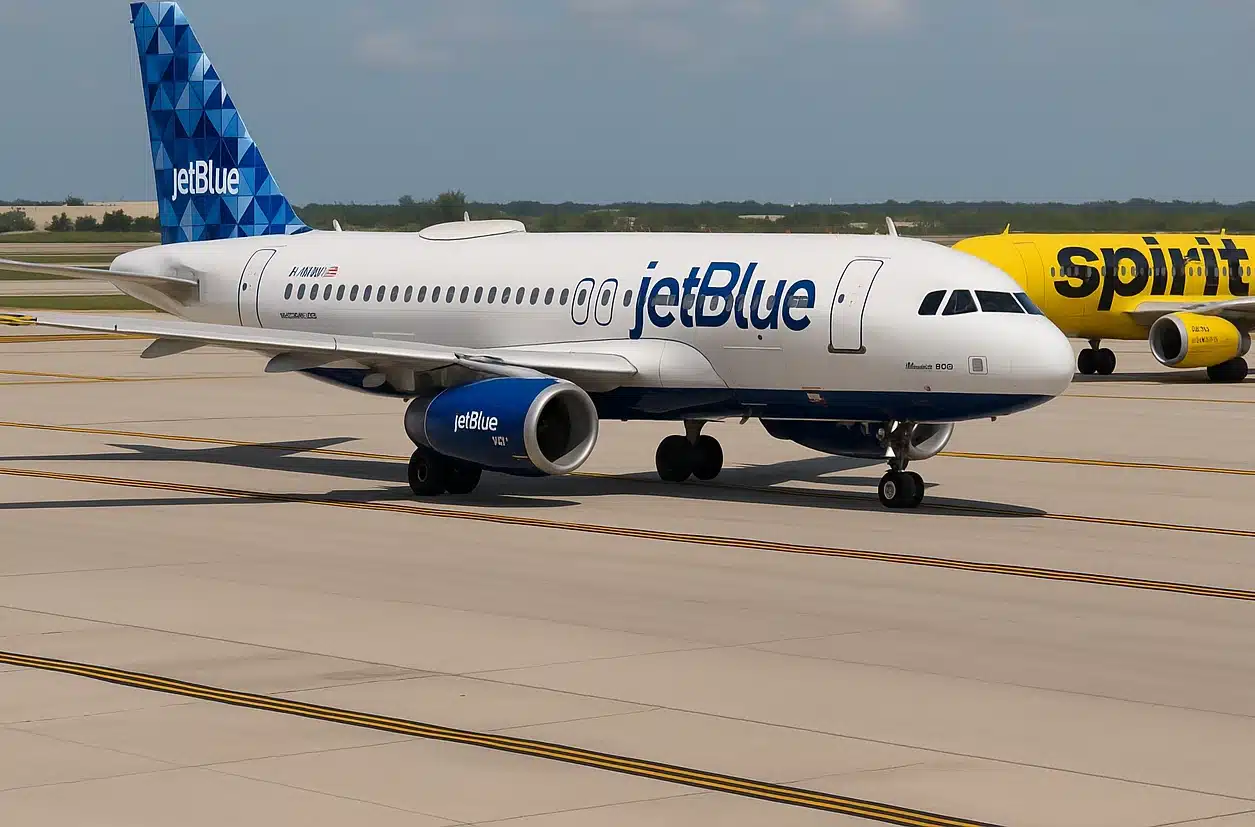
Frontier exclusively operates the Airbus A320NEO family, equipped with Pratt & Whitney geared turbofan engines which have some of the most fuel-efficient powerplants in commercial aviation today. Competitors like Spirit and JetBlue still partly operate fleets consisting of older CEO-generation aircraft, which lack those efficiency gains entirely.
Specifically, the main differentiator fleet-wise for Frontier Airlines is the Airbus A321NEO. The A321NEO is the largest aircraft in the A320 family, and Frontier uses it in a high-density configuration.
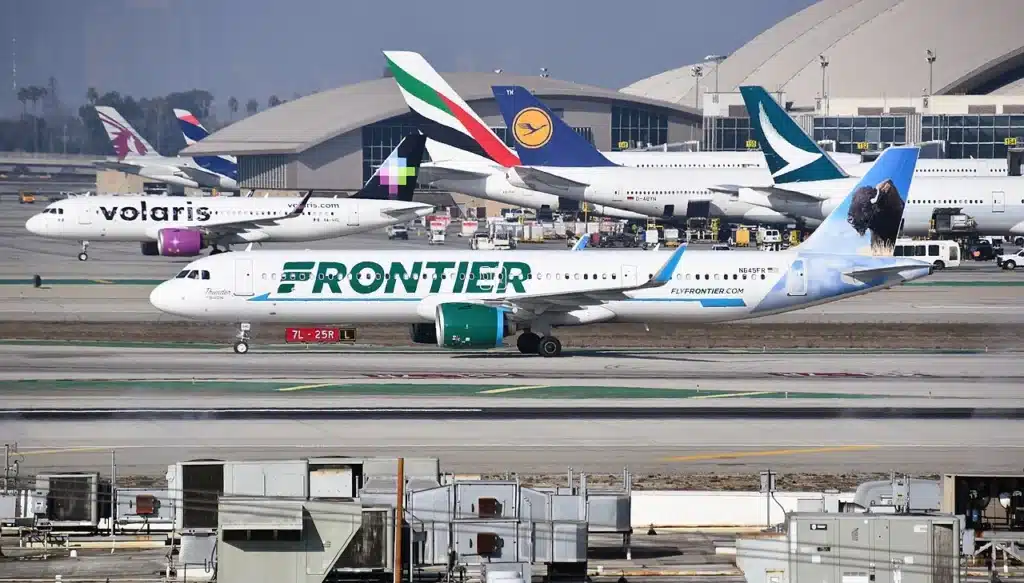
More seats per flight means a lower cost per available seat mile (CASM). If your revenue per available seat mile outpaces the cost per available seat mile, you’ll likely be on your way to profitability. Bigger plane, efficient fuel, more passengers splitting the bill equals a good spot to be in. A long as you maintain good load factors on that particular route.
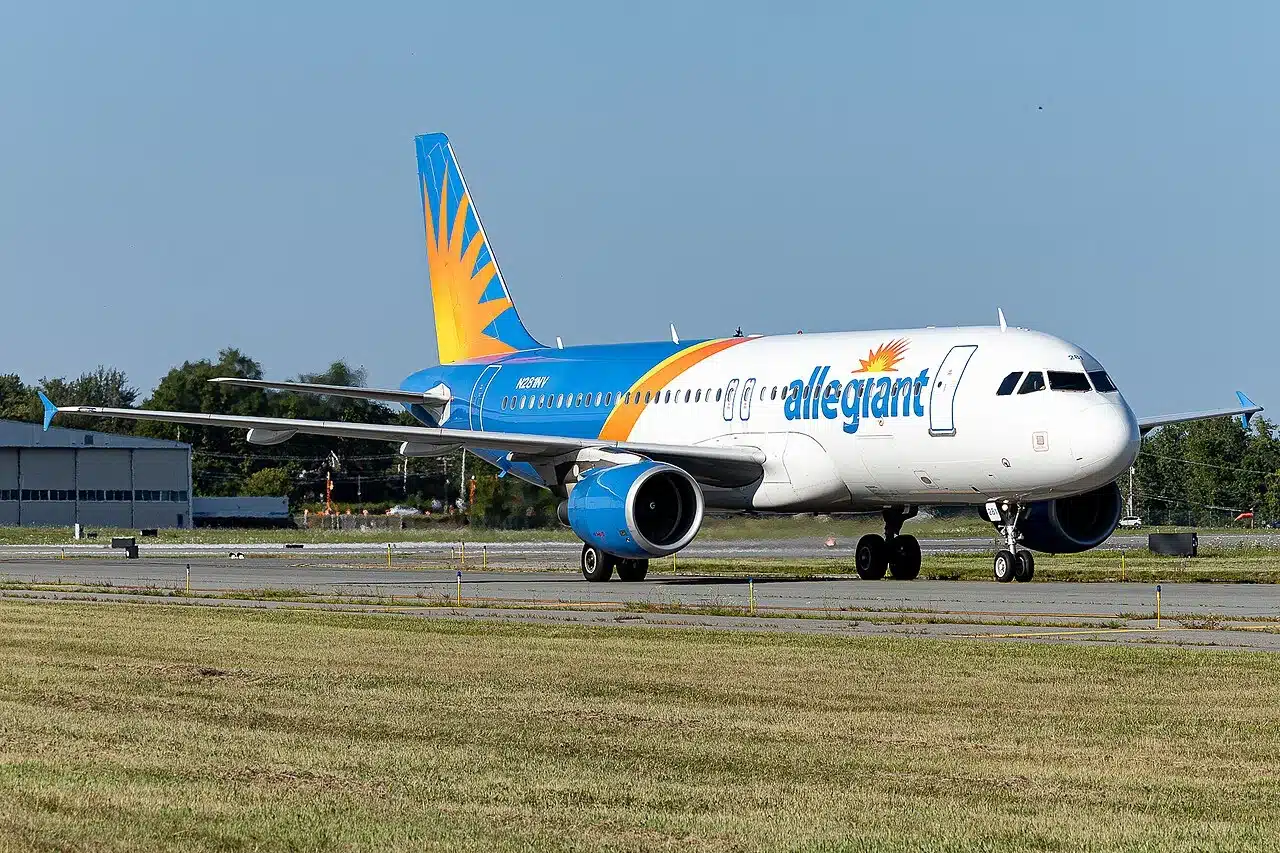
ULCC competitors Allegiant and Sun Country don’t use or fly an equivalent of the A321NEO. Spirit Airlines operates a fleet of Airbus A321NEOs but that fleet is fraction of the size of Frontier’s A321NEO fleet.
Frontier is hyper-vigilant on weight enforcement. Every checked bag is verified against the 50-pound limit. Carry-ons are checked for size compliance, with steep fees for oversized items. There’s no inflight entertainment system onboard. Screens, wiring, and associated electronic components add weight, and more weight costs fuel.
Finally, Frontier doesn’t rely on a hub-and-spoke model. Flying direct between cities reduces time spent idling at congested hub airports. That means less ground time with engines running, less wasted fuel.
The honest answer is that no airline is coming through the 2026 oil crisis unscathed. Frontier has raised its already steep bag fees in response to higher fuel costs, joining Delta, United, JetBlue, and Southwest in passing some of that burden to passengers.
Like most carriers, Frontier revisited its 2026 forecasts. This Iran War appeared on no one’s planning horizon.
But the question isn’t whether Frontier is profitable right now. It’s whether their model holds up better than average when fuel prices spike. To answer that, we can look back at the last time jet fuel hit this price range: the first half of 2022, following the start of Russia’s invasion of Ukraine.
Six Months Ending June 30, 2022 (Period covering onset of Russia-Ukraine War fuel shock)
| Airline | $ in Fuel Spent | Revenue Per Seat Mile | Cost Per Seat Mile | Δ |
| Frontier | $550,000,000 | $0.1007 | $0.1104 | -$0.0097 |
| Delta | $5,315,000,000 | $0.2027 | $0.2093 | +$0.0066 |
| United | $6,041,000,000 | $0.1741 | $0.1698 | -$0.0043 |
| Southwest | Data Not Found | $0.1593 | $0.1452 | -$0.0141 |
| Spirit | $927,218,000 | $0.0990 | $0.1099 | -$0.0109 |
Every airline except Delta posted a net loss per seat mile. Frontier was in the red, but losing less per mile than Southwest or Spirit. Two carriers that cater to the budget conscious consumer.
Now compare that to a calmer baseline period in early 2025, before the Iran War disrupted fuel markets.
Six Months Ending June 30, 2025 (Baseline: no major fuel disruption)
| Airline | $ in Fuel Spent | Revenue Per Seat Mile | Cost Per Seat Mile | Δ |
| Frontier | $230,000,000 | $0.0908 | $0.0968 | -$0.006 |
| Delta | $4,869,000,000 | $0.2101 | $0.1918 | +$0.0183 |
| United | $5,476,000,000 | $0.1784 | $0.1662 | +$0.0122 |
| Southwest | 2,575,000,000 | $0.1546 | $0.1546 | $0.0 |
| Spirit | $407,296,000 | $0.1185 | $0.1161 | +$0.0024 |
Comparing Q1-Q2 2022’s crisis to the relatively quiet Q1-Q2 2025, Frontier was the only airline still losing money per seat mile even in a stable environment. That’s a real problem and worth addressing honestly.
But look at the consistency. During the 2022 fuel shock, Frontier lost roughly $0.0097 per ASM. During a calm, high-demand period in 2025, they lost $0.006 per ASM. Their loss barely moved. Meanwhile, every other airline saw meaningful swings in performance between the two periods.
That consistency is the story. Frontier’s model just doesn’t generate big wins, but it also doesn’t collapse under pressure. Their operation is optimized to a degree where fuel shocks don’t dramatically change the math.
Delta and United could very well be managing fuel better but that’s not the full story. They have revenue streams that Frontier doesn’t. Premium cabins, intercontinental routes, airport lounges, co-branded credit cards, and great loyalty programs all generate income that help subsidize their service product. When fuel prices rise, those revenue cushions absorb the blow.
Southwest’s advantage has historically been tied to brand loyalty. Customers would continue to pay whatever the airline asks because bags flew free and passengers could sit anywhere they wanted. Southwest made significant changes to its bag and seating policies in Q1 2025, sending a shockwave to part of its core customer base right as the Iran War is driving up costs. Their next earnings report will be telling.
Frontier has none of these buffers. No over-the-top premium product. No robust international or business network. A mid-tier loyalty program for customer retention. Their customer base chooses them for one reason: price. And while the fuel-efficient operation supports low prices, it doesn’t generate the kind of margin cushion that protects bigger, more established carriers.
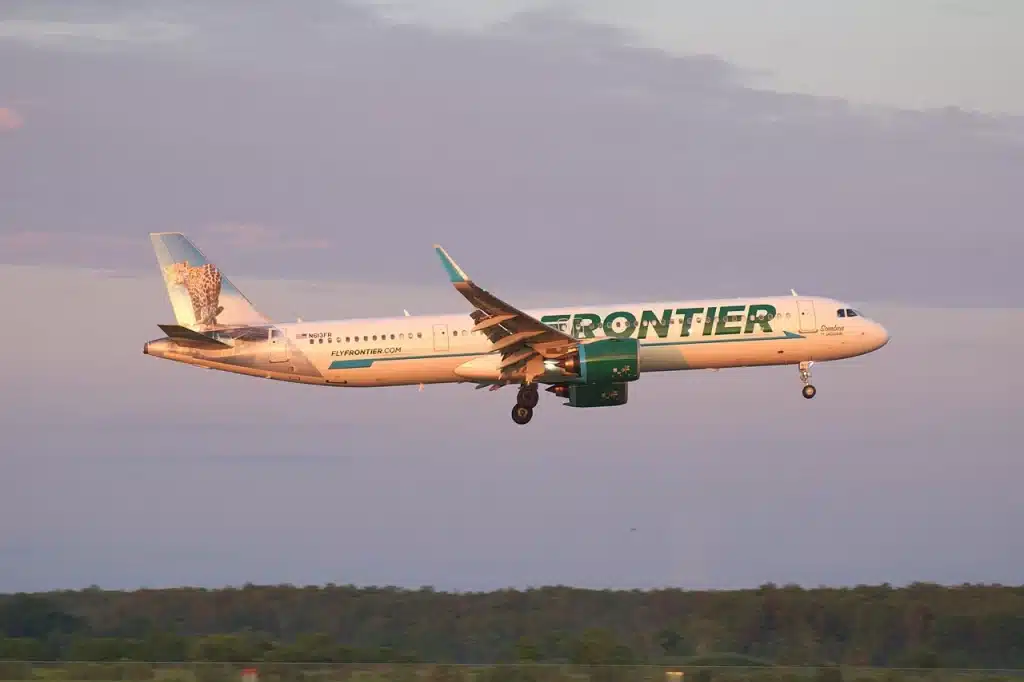
Frontier isn’t going to fold over rising fuel costs. Their model was built for exactly this kind of environment, and the historical data backs that up. On a long enough timeline, can Frontier nosedive due to high fuel costs due to the Iran War? Absolutely. But most airlines would also.
But Frontier’s fuel operation and the customer experience are separate problems. Fuel efficiency keeps the lights on. Brand perception determines whether the airline grows or just survives.
Right now, Frontier is cutting routes, trimming its fleet, and narrowing its network to manage costs. That’s a financially defensive posture, not a growth one. Meanwhile, other U.S airlines with deeper revenue streams are better positioned to expand when conditions improve.
The long-term challenge for Frontier isn’t fuel. It’s answering a question their customers are already asking: Why fly Frontier when I don’t have to? No complimentary snacks, no free bags, no WiFi, no fringe benefits. Just a cheap fare from A to B, provided you don’t get hammered by any of their fees.Frontier gets you where you’re going as cheaply as possible. For both you and them. That’s a legitimate value proposition for a specific type of traveler. But until the airline gives customers a reason to prefer them rather than just settle for them, their ceiling is going to stay low regardless of what happens at the pump.