The Helpful Guide to Frontier’s Airbus A321 Aircraft
Frontier's Airbus A321 is a versatile aircraft capable of flying short and long flights. Find out everything you need to know about flying on this aircraft.

United’s new Coastliner puts JetBlue Mint in a tough spot. We break down what it means for JetBlue’s future and whether a United merger makes sense.
A few short days after we were predicting JetBlue had a chance at a domestic comeback, news broke that the airline is quietly shopping itself to potential merger partners. We don’t know what’s happening in the back rooms, and there’s a huge possibility that nothing may ultimately come of it. But it’s not a great sign for an airline that still hasn’t stopped the financial bleeding.
At the same time United, who has been performing well above its own expectations, announced its largest aircraft order to be fulfilled by 2028. The order includes the Airbus A321XLR, Boeing 737 MAX, and Boeing 787-9.
But the attention grabber, at least for us, is that United is acquiring more A321NEOs configured specifically for transcontinental routes with elevated premium seating. United is calling them Coastliners.
Is this a problem for JetBlue? Absolutely. One of the core deliverables of JetBlue’s JetForward initiative was establishing a credible domestic First Class product. That’s JetBlue Mint.
The Coastliner just made already choppy seas a little rougher. But here’s the caveat, could United’s hard pivot toward premium passengers send cost-conscious travelers straight into JetBlue’s arms?
Let’s make the case both ways.
United is doubling down on a trend that Delta already proved out: premium revenue can outpace economy revenue. The math is simple. The front of the plane typically subsidizes the back, with loyalty programs and co-branded credit cards generating the incremental profit on top. This is a great situation to find yourself in, as premium customers tend to be more loyal to one airline unlike the average cost conscious traveler, who tends to be more agnostic when it comes to airline loyalty.
The big three U.S. carriers have long offered premium-heavy configurations on routes between major business centers like New York City to San Francisco and Los Angeles. United’s Coastliner won’t stray away from that notion.
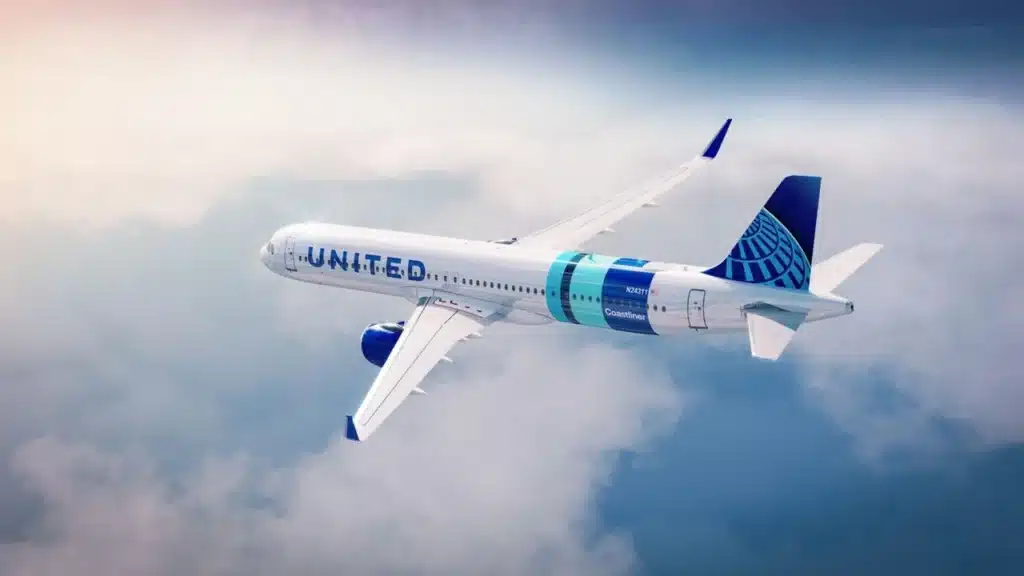
The first launch of the Coastliner will be on flights between Newark to San Francisco & Los Angeles in Summer 2026. United will configure the interior with Polaris business class seating as well as a snack bar, sacrificing economy capacity in the process. The target audience is the frequent business traveler who makes these “transcon” runs regularly.
What United actually accomplishes here is straightforward. They will retire the aging Boeing 757 narrowbodies on these high-yield routes and replace them with a fresher, more premium cabin experience.
The product isn’t radically different. It’ll be a newer Polaris cabin featuring all-aisle lie flat seating on a more modern airframe. But in business travel, perception matters, and “new” carries weight.
JetBlue Mint is genuinely one of the best premium class products any U.S. airline currently offers. It might be surprising to some but JetBlue Mint is an award winning product. But the problem isn’t the product. It’s JetBlue’s deployment of Mint domestically.
Mint makes complete sense on the high-yield flights like New York to Los Angeles or New York to San Francisco. JetBlue has that right. What’s harder to defend is the deployment of Mint on leisure routes. That’s because leisure flying is JetBlue’s bread and butter. Not business travel.
Flights like Fort Lauderdale to Phoenix or Las Vegas are such examples of Mint being deployed on leisure routes. The issue isn’t that zero demand exists for Mint to vacation spots. The problem is yield dilution.
Every underperforming premium seat is an opportunity cost against JetBlue’s already thin margins. A Mint-equipped aircraft reduces economy capacity: a standard JetBlue A321NEO fits 200 Core Economy customers, while the Mint A321 configuration holds only 143.
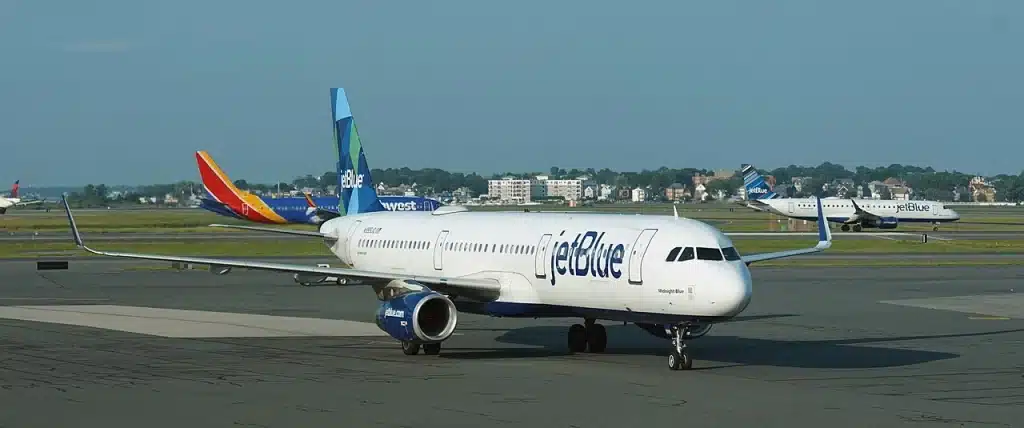
While this capacity drop won’t bankrupt the airline overnight, it creates a difficult utilization dilemma. Is it better to keep Mint-equipped planes grounded for use on high-yield routes only? Or is it better to sacrifice economy seats and fly Mint on a leisure route just to keep the planes moving?
Out of those two options, JetBlue has chosen the latter prioritizing aircraft utilization over optimized seat density, even if it means flying a premium product where it isn’t truly needed.
Another but deeper issue is one of brand positioning. JetBlue built its identity around leisure travel involving Florida, the Caribbean, Latin America, transatlantic to major European cities.
It provides a strong leisure network, but it doesn’t scream “corporate travel program.” When a CFO or an executive assistant is booking business travel…United, Delta, and American come to mind first.
That mental branding is hard to override, and even a legitimately excellent product like Mint has to fight uphill against it. JetBlue doesn’t quite have the “prestige” branding or infrastructure (like competitive lounges to United or Delta) that makes a business traveler feel like they’re making the safe, obvious choice for their (or their companies’) travel investment.
United’s fleet announcement landed right as JetBlue leaked a public signal that it may be open to a merger. That timing isn’t great optics for the smaller carrier.
JetBlue’s financial struggles are well documented. The airline changed leadership, and current CEO Joanna Geraghty launched JetForward. JetForward is a strategic plan focused on cutting underperforming routes and building a stronger foothold in the business travel segment, all in efforts to launch JetBlue back to profitability. The initiative makes sense. But the results haven’t moved the needle enough to get the airline back to sustained profitability as of yet.
Layer on the failed Spirit merger and the court-ordered break up of the Northeast Alliance with American Airlines, and JetBlue has been playing catch up for a while. Now the airline has reportedly engaged advisors to evaluate merger feasibility with Alaska, Southwest, or United.
This may amount to nothing. But it’s worth noting that JetBlue already has a federally approved partnership with United in place. Of the three options being floated, a United acquisition would be the smoothest operational transition by a significant margin.
The strategic upside for United is real. JetBlue’s network in Florida, the Caribbean, and Latin America would immediately strengthen United’s competitive position against American Airlines in those markets. A region where American has long held a dominant edge.
United’s premium pivot isn’t without risk. The reality is that most people flying United domestically are not sitting in Polaris. They’re in economy, and they’re price-sensitive.
The Coastliner trims the economy seat count on these transcontinental routes to make room for premium seats. If United doesn’t supplement those flights with standard high-density A321s or 737 MAXs on the same routes since the Boeing 757 will be fading into the sunset, economy seat supply shrinks. Which pushes fares up. Lower supply, same or higher demand equals higher prices. Basic supply and demand principles.
United’s standard Airbus A321NEOs fit 180 standard United Economy seats. The Coastliner will shrink that total to 129. Revenue from those missing economy seats will begin to add up if you don’t raise fares.
Travelers priced out of United start looking at alternatives. JetBlue operates its own A321s on these same routes, and with fewer Mint-configured A321s cabins than United has Polaris, they have more economy seat volume available to absorb those displaced passengers.
To be fair, United has almost certainly scoped this out already. They’re not going to leave money on the table by abandoning economy passenger demand on one of their most valuable domestic routes. They also operate Boeing 787s & Boeing 777s on these routes, so we’ll need to wait and see if those types are completely removed from operation, replaced by the Coastliner or not.
But even with hedging, the scenario where a fraction of economy passengers migrate toward JetBlue is plausible. For JetBlue, even a modest influx of displaced passengers moves the load factor needle.
For JetBlue, the smart short-term move is to watch and collect data. If Coastliner launches and JetBlue’s load factors on transcontinental routes hold steady or improve from the overflow, JetForward gets a boost and the merger conversation becomes much easier to walk back.
The current numbers are worth paying attention to. On the JFK-SFO route, JetBlue is running load factors between 84-87%. United on the EWR-SFO route is running 87-89%. On the JFK-LAX route pairing, JetBlue sits at 82-83% while United runs 84-87% out of Newark. The gap is real but it’s not a blowout. JetBlue is competitive on these routes today. The question is whether the Coastliner changes that equation.
| Airline | Route | Departures | Passenger Seats Available | Passengers Served | Load Factor |
| JetBlue | JFK – SFO | 1,890 | 300,289 | 254,584 | 84.77% |
| United | EWR – SFO | 3,670 | 867,748 | 761,119 | 87.71% |
| JetBlue | SFO – JFK | 1,880 | 298,787 | 259,626 | 86.89% |
| United | SFO – EWR | 3,658 | 864,631 | 772,764 | 89.37% |
| JetBlue | JFK – LAX | 3,396 | 536,493 | 441,027 | 82.20% |
| United | EWR – LAX | 3,457 | 786,752 | 662,786 | 84.24% |
| JetBlue | LAX – JFK | 3,385 | 534,412 | 444,998 | 83.26% |
| United | LAX – EWR | 3,420 | 779,382 | 676,063 | 86.74% |
But if load factors soften on those routes, the math gets uncomfortable fast. It would signal that United is winning the business traveler and properly managing the economy seat situation or sending the economy traveler to lower-cost options that aren’t JetBlue. That’s a squeeze from both directions.
In that scenario, a United acquisition starts to look less like a failure option and more like the most logical exit available. A JetBlue merger with Southwest or Alaska would likely draw serious regulatory scrutiny. Not because it mirrors the Spirit situation exactly, but because combining any two of the remaining independent low-cost carriers shrinks the competitive options available to budget-conscious travelers in overlapping markets. Regulators have historically shown they’re paying attention to exactly that. United is the cleaner fit, structurally and strategically.
United would be smart to keep the JetBlue brand intact post-acquisition. The two airlines are targeting fundamentally different customers. United wants the loyal business traveler. JetBlue wants the family heading to Cancún. Running them as parallel brands, a model not unlike Air France-KLM’s multi-brand structure preserves both customer bases and avoids the operational chaos of a full integration. JetBlue keeps its identity. United gets the network. Customers keep a genuine low-cost option.
That’s not a bad outcome for anyone.
United’s Coastliner is worth watching. It will be fascinating to see whether business travelers respond the way United expects.
JetBlue will be watching too, very closely. Their Mint-equipped A321s are in direct competition with what United is building. The problem for JetBlue is that United comes to the table with stronger brand equity in business travel.
Mint is excellent. But “excellent product, leisure brand” is a harder sell in the corporate travel market than “the obvious choice, now with a nicer cabin.”
If Coastliner gains traction, it could put real pressure on JetBlue’s load factors on the routes that matter most to JetForward. That would push Mint toward leisure routes where the yield doesn’t support the product and that’s a terrible situation for JetBlue to be put in.
A United acquisition may be the best outcome JetBlue can realistically hope for right now. It doesn’t make for a great headline. But it solves the profitability problem, preserves the brand, and potentially keeps a low-cost option alive for the travelers who need it most.