Breeze Airways Continues Forward Momentum – Adds Routes from Albany
Breeze Airways has announced three new routes from Albany starting in June 2025. Learn more about these routes and what it means for Breeze customers.

Breeze Airways’ BreezeThru is quietly reshaping U.S. low-cost flying. Here’s why it’s their best weapon against the Allegiant and Sun Country merger.
Breeze Airways doesn’t grab many news headlines. While other U.S. carriers seem to be constantly releasing press releases about premium cabins and loyalty program overhauls, Breeze has been quietly building something more interesting. They’re building a route network that reaches airports most travelers forgot existed, all backed by a product called BreezeThru, something no other U.S. carrier currently offers.
With Allegiant Air and Sun Country soon operating as one, the secondary airport low-cost market could potentially get more consolidated and more competitive. We don’t know for sure until we learn more details about how Allegiant and Sun Country will function post-acquisition. However, Breeze makes a compelling case with BreezeThru that could propel them ahead of the combined carrier.
We’ll touch on why BreezeThru is Breeze’s best weapon heading into this new era and identify areas of softness with the product that may affect Breeze’s future growth.
BreezeThru is pretty simple in concept. Breeze operates flights between secondary destinations with an intermediate stop, typically around 30 minutes. During this stop, some passengers deplane and new ones board, while through-passengers stay seated. Your bags stay on the plane. You stay on the plane. The stop is operational, not a connection.
A real example: a flight marketed from Long Island MacArthur (ISP) to Akron, Ohio stops at Myrtle Beach. Passengers heading to Myrtle Beach get off. Passengers heading to Akron don’t move. It’s not a connection. It’s a quick pit stop. Think more like a station along a bus route than a hub transfer.
Originally, through-passengers had the option to deplane briefly and reboard with ID and ticket. That appears to have been phased out. Flight attendants now conduct a headcount after the intermediate stop, keeping the process cleaner and faster.
BreezeThru isn’t just a customer convenience. It’s pretty essential to Breeze’s survival. Breeze has averaged a 77% load factor over the past two years, trailing Allegiant and Sun Country, who have both consistently posted load factors above 82%. That gap matters enormously on thin low-cost margins.
BreezeThru closes that gap cleverly. It lets Breeze operate a de facto hub-and-spoke model without officially committing to one. Breeze can market a route like Lansing to Tampa, a market with genuinely weak standalone demand, and make it financially viable by picking up passengers in Norfolk on the way down. The Lansing passenger avoids driving to Detroit or Grand Rapids. Breeze fills the plane. Both sides win.
The results are starting to show. Year-over-year from 2024 to 2025, Breeze grew total passengers served by 46% while expanding destinations from 67 in 2024 to 78 by the end of 2025. Net profit is still negative, but the trajectory has shifted meaningfully.
| Airline | Net Revenue (2025) | Operating Costs (2025) | Net Profit (2025) | Net Profit (2024) | Net Profit Change YOY |
| Breeze Airways | $885,000,000 | $916,000,000 | -$31,000,000 | -$103,000,000 | 69.9% |
| Allegiant Air | $2,499,000,000 | $2,338,000,000 | $161,000,000 | $86,000,000 | 87.2% |
| Sun Country Airlines | $1,106,000,000 | $998,000,000 | $108,000,000 | $97,000,000 | 11.3% |
Despite still being in the red, net profit year over year has improved greatly for Breeze Airways. They’ve outpaced Sun Country Airlines and come close to Allegiant Air, which is a much larger airline.
Allegiant’s model is built around operational cost discipline. They fly only when it’s profitable and ground the plane when it isn’t. That conservatism has made them one of the most financially stable ULCCs in the country, but it also caps their growth ceiling. They’re not going to start operating multi-stop through-routes to chase load factors. It’s just not in their DNA.
Sun Country operates similarly, though their pending merger with Allegiant adds an interesting wrinkle to their operation, but it doesn’t fundamentally change their approach to secondary market flying.
However, like Breeze, Sun Country also has a hedge. Sun Country flies mostly seasonal leisure routes during the winter months, but during the warmer months they pivot toward their cargo operation. While Breeze cannot replicate the cargo element, smaller airlines need another way to bring in revenue to remain economically viable. For Breeze, their only lever is higher aircraft utilization, which BreezeThru helps accomplish.
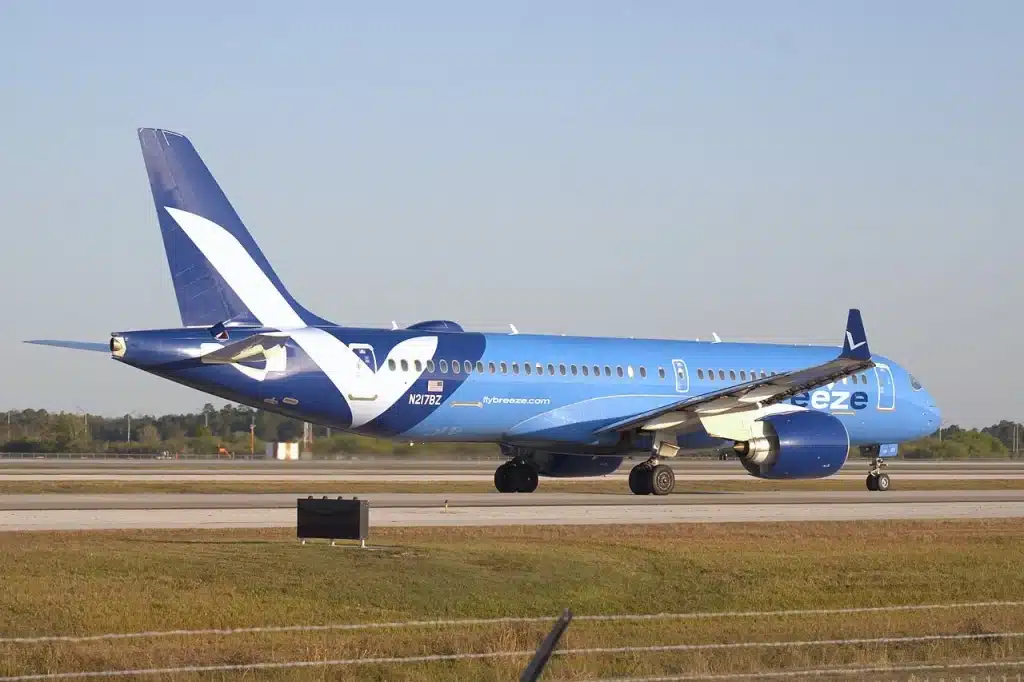
Breeze is also running a younger, leaner fleet of primarily Airbus A220s with significantly better fuel efficiency than Allegiant’s and Sun Country’s older narrowbody aircraft, helping with costs.
The airline is paying their crews to keep planes moving and generating revenue, while Allegiant and Sun Country are paying crews to wait. On a per-aircraft basis, Breeze is extracting more bang for their buck, averaging more departures per aircraft than both Sun Country and Allegiant in 2025.
| Airline | Total Departures | Active Aircraft Fleet | Average Departures Per Aircraft | Revenue Per Departure |
| Breeze Airways | 61000 | 53 | 1150 | $14,508 |
| Allegiant Air | 115000 | 122 | 942 | $21,730 |
| Sun Country Airlines | 24000 | 63 | 380 | $46,083 |
But the most striking number in this table is Sun Country’s revenue per departure. The combination of cost discipline, high-yield seasonal routes, and a cargo business proves it’s possible to work smarter, not harder. BreezeThru is Breeze’s version of that philosophy. Not quite running on all cylinders profitability-wise yet, but a meaningful step in that direction.
BreezeThru isn’t without its weaknesses, and that deserves some realistic coverage.
The biggest one is disruption vulnerability. BreezeThru creates a dependency chain. If a snowstorm shuts down Albany, passengers connecting through Norfolk to Fort Myers don’t just miss a flight. They potentially lose a vacation weekend. Breeze’s network is far smaller than the major players, so rebooking options are limited.
The second issue is market staying power. Breeze has a well-documented pattern of entering and exiting markets quickly. BreezeThru’s math only works if both ends of the route generate enough demand. At a large secondary airport like Providence or Hartford, that’s plausible. At Plattsburgh or Ogdensburg, you burn through existing demand fast and end up flying more than half-empty planes to Norfolk just to make your margin there. That’s not sustainable. Might as well cut the first route.
Finally, the customer perception problem is real. If you market a flight from Providence to Los Angeles, that’s what the customer expects. A 30-minute stop isn’t a deal-breaker for a price-conscious traveler, but it is when Southwest or JetBlue offers a true nonstop at a comparable price. Breeze needs to be transparent in its marketing and lean into the price advantage to justify the trade-off.
BreezeThru helps move Breeze out of a direct comparison with Allegiant and Sun Country and into a different competitive lane. Breeze is starting to offer a service that runs parallel to what JetBlue, Alaska, and Southwest provide. While it’s unlikely they’ll ever displace those carriers, they do make a competitive case in at least one important category.
These major low-cost carriers have significantly worse on-time performance records than Breeze. The table below outlines October 2025 on-time performance among U.S. airlines and provides a snapshot of how Breeze outperforms the rest in that category.
| Airline | % of flights on time in October 2025 |
| Breeze Airways | 87.28% |
| Southwest Airlines | 76.23% |
| JetBlue Airways | 76.38% |
| Alaska Airlines | 80.26% |
While this snapshot is a small sample size, and these larger low cost carriers have much bigger networks with more room for error, it just shows how efficient Breeze Airways has nailed down their operation.
A missed connection on JetBlue due to a delayed flight can cost you a day. On BreezeThru, your bags and your seat don’t move. That’s a genuine differentiator and a real benefit for the traveler.
Breeze won’t beat any of the major low-cost carriers on brand recognition anytime soon. But they don’t need to. They need to be the obvious choice for cost-conscious travelers in secondary markets who are tired of driving two hours to a major hub, and BreezeThru is the product that makes that pitch credible.
Breeze is still losing money, but there is a lot of upward momentum. BreezeThru is the engine of that change. It’s solving Breeze’s load factor problem while simultaneously creating a product that neither Allegiant nor Sun Country can easily replicate, and perhaps one that none of the major low-cost carriers can match either.
The Allegiant and Sun Country merger will create a more formidable secondary airport competitor on paper, but they’ll likely remain a conservative one in practice.
BreezeThru isn’t perfect. Weather disruptions and thin secondary markets are genuine risks. But as a strategic hedge for a young airline still finding its footing, it’s working and that’s worth paying attention to.