PLAY Airlines: Affordable Flights from America to Iceland and Europe
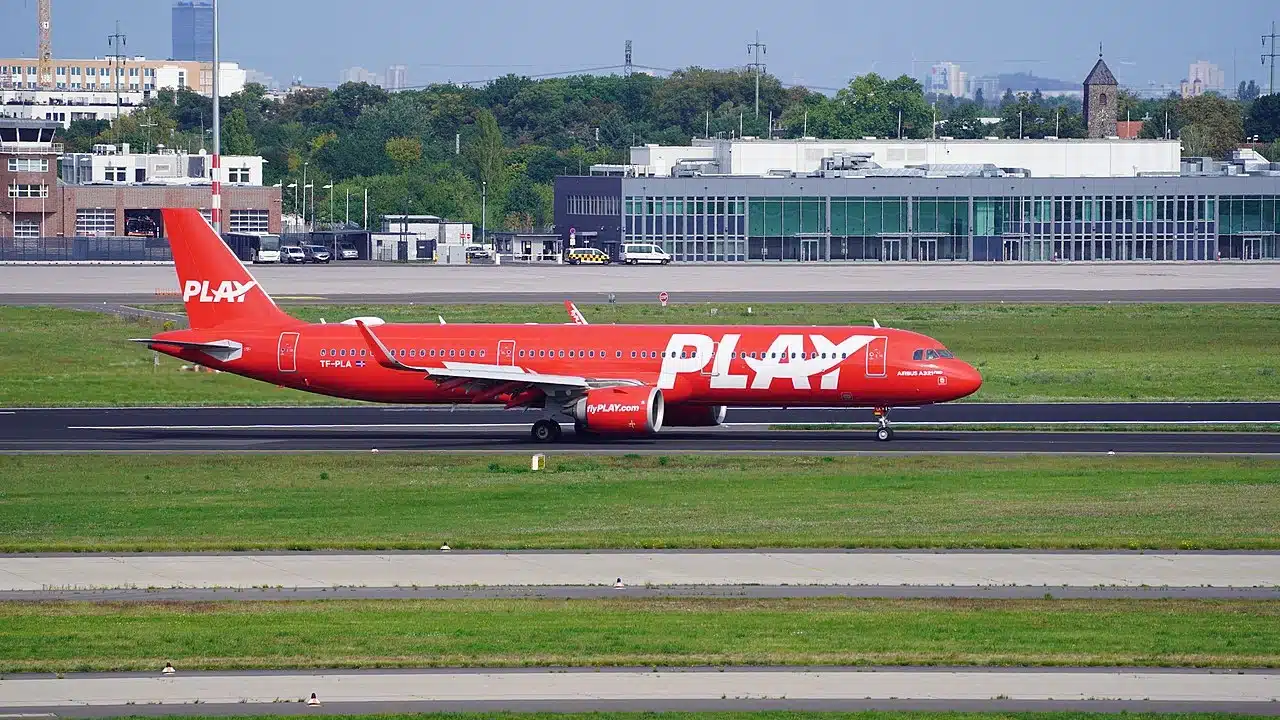
PLAY Airlines started flying between the U.S and Iceland in Summer of 2022. Today, they fly from three U.S cities. Learn more about PLAY U.S - Iceland service.

Avelo Airlines will be getting Embraer 195-E2s in 2027. However, they are pivoting their strategy to get ready for them. They luckily have Porter as a roadmap.
Avelo Airlines is hanging its future on their newly ordered Embraer 195-E2s. This gamble has already caused dramatic changes within the airline. They’ve ceased all West Coast operations, closed multiple crew bases, and begun phasing out their older Boeing 737s.
These changes convey a pretty clear message. Avelo is abandoning their dream of becoming a national ultra-low-cost competitor to Spirit and Frontier Airlines, at least for now. For this newer airline, that’s exactly the right move.
Avelo’s business model just didn’t fit the mold of a large ultra low cost carrier. The airline has built its brand around serving secondary markets like New Haven and Wilmington by creating a hub-and-spoke network from these airports connecting to smaller destinations.
The Avelo brand doesn’t seem appetizing to the masses, but it does offer convenience for travelers who want to avoid congested major airports at all costs.
Avelo’s recent pivot is intriguing to follow because they have a roadmap to use. Porter Airlines, a regional carrier in Canada, experienced tremendous growth after adding the Embraer 195-E2. If Avelo can replicate even a portion of Porter’s success, the airline may have found its path to profitability.
This article explores why Porter Airlines thrived after bringing on the Embraer 195-E2, why Avelo could be next to experience similar growth, and what customers can expect from Avelo’s new fleet in both the short and long term.
Without rehashing all the details of Avelo’s Embraer acquisition, which we covered previously, it’s worth examining the recent changes that signal the airline is going all-in on its new fleet strategy.
Avelo has recently closed several crew bases on the East Coast, most notably in Wilmington and Raleigh, North Carolina. This has virtually zero impact on customers, but it showcases that the airline is consolidating operations around a smaller number of airports it deems viable as bases.
The airline has also scaled back its international expansion. In late 2024 and early 2025, Avelo began flights to Jamaica, Mexico, and the Dominican Republic. Months later, some flights to Cancun and Jamaica were discontinued.
This is puzzling considering that Avelo is an ultra low cost airline targeting leisure destinations where demand should have been strong.
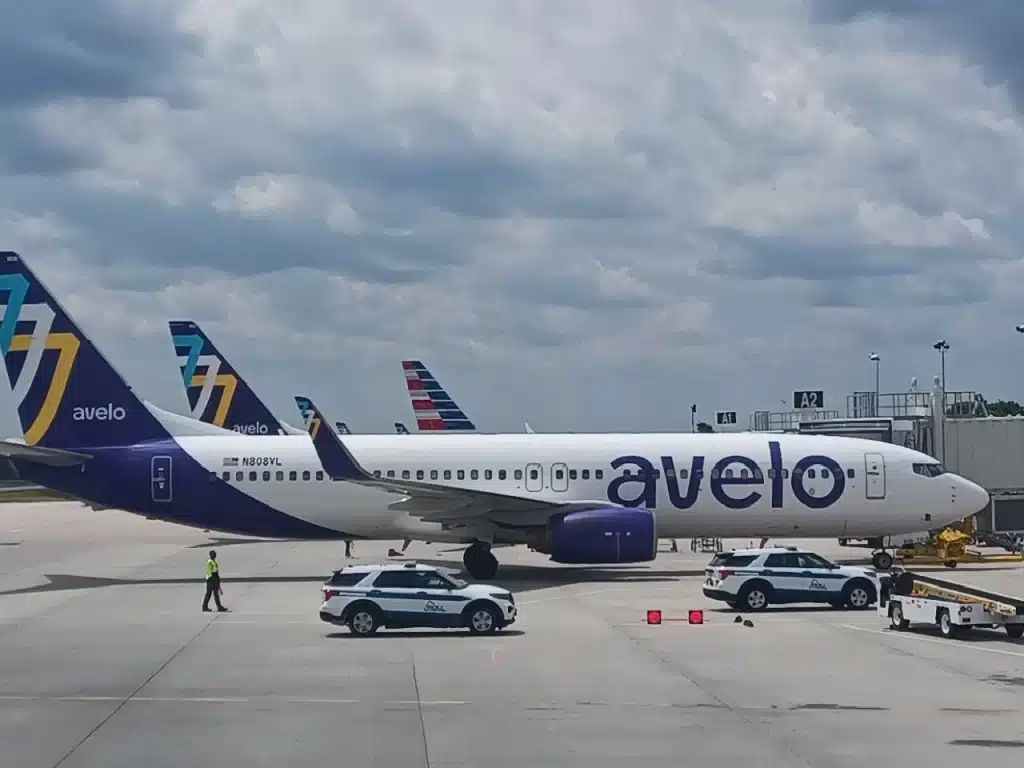
Whether Avelo wants to admit it or not, the airline is bleeding money. Customer perception took a significant hit following the airline’s participation in deportation flights.
The numbers tell the story: Avelo lost $23 million in 2025, up dramatically from $2 million in 2024. This occurred even as the airline generated more revenue year-over-year and improved load factors to 76% in 2025. Revenue is growing and demand is increasing, yet the airline continues to lose money.
| Airline | CASM (2025) |
| Avelo Airlines | $11.85 |
| Allegiant Air | $11.40 |
| Sun Country | $12.42 |
| Spirit Airlines | $11.94 |
| Frontier Airlines | $9.77 |
| Aircraft | Fuel Burn Per Hour (LBS) |
| Boeing 737-800 | 5500 |
| Embraer 195 E2 | 4200 |
The culprit is operating costs. The Boeing 737 Next Generation series is simply too expensive to maintain and operate profitably on low-yield routes.
Looking at the tables above, Avelo sits in the middle of the pack among ultra low cost carriers when it comes to cost per available seat mile.
Frontier leads the competition significantly, likely because they operate newer jets exclusively while charging passengers heavily for any creature comforts. Avelo, Sun Country, and Spirit are all known for using older planes.
The upgrade to the Embraer 195-E2 should help the bottom line on fuel costs substantially. The E2’s fuel burn per hour is significantly lower than the Boeing 737-800’s, and the newer aircraft will also require less maintenance.
These financial realities led Avelo to make a life-or-death decision to invest in the Embraer 195-E2, funded by a recent cash infusion.
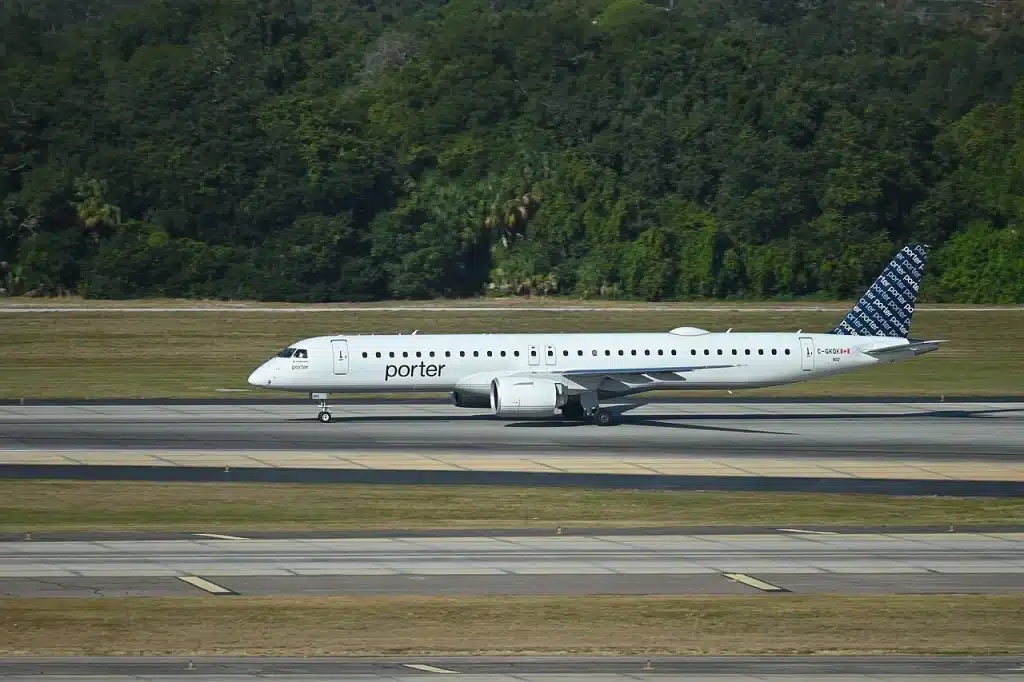
To better understand Avelo’s potential future, you need to examine Porter’s turnaround story first.
In Canada, Air Canada dominates the airline market. Several smaller airlines exist, but they struggle to capture meaningful market share against Air Canada. For years, Porter Airlines fit that mold.
From its inception, Porter operated almost exclusively from Downtown Toronto’s Billy Bishop Airport, not the city’s main international hub.
Billy Bishop’s short runways forced Porter to fly only Dash-8 turboprops at reduced capacity to guarantee safe takeoffs.
Porter repeatedly suggested expanding Billy Bishop and even tried to extend runways to accommodate jets, but government officials blocked those efforts.
Porter fully understood that its turboprop fleet was capping both its network and overall growth potential.
In 2022, Porter began taking deliveries of the Embraer 195-E2. Since then, the airline’s direction has changed completely.
Porter now operates from Toronto Pearson International Airport and has expanded operations from Ottawa International Airport. They now fly transcontinental routes across Canada and offer flights pushing deeper into the United States, with service from Toronto as far as Los Angeles and Las Vegas. All of which would have been impossible with turboprops.
Before the E2, Porter Airlines carried only 2 million passengers annually through its regional network. Since adding the E2, that number has grown to nearly 5 million passengers per year. According to Aviation Outlook, Porter Airlines must now be sitting around $1.3 billion dollars in annual revenue. You don’t generate that much revenue flying regional hops with a turboprop.
The fleet upgrade fundamentally changed Porter’s destiny. Now for Avelo, the same transformation is on the horizon.
Avelo’s current predicament mirrors Porter’s in several ways, despite differences in their business models.
Avelo is a small fish in a competitive pond, just like Porter was against Air Canada. Avelo competes against more prominent ultra low cost carriers like Spirit and Frontier, while also facing direct competition from Allegiant and Sun Country.
Allegiant and Sun Country (soon to be one combined airline) share Avelo’s business model. Yet Avelo is significantly smaller and less well-known than both. The odds are stacked against Avelo’s favor.
Avelo once tried to serve both coasts simultaneously and failed. The airline has since focused on the East Coast, where the bulk of its popular hubs and destinations are located.
Porter faced a similar scenario. They primarily operated in Eastern Canada with flights from Toronto throughout Ontario and Nova Scotia.
Internationally, Porter was limited to the Northeastern United States due to the Dash-8’s range restrictions. With Avelo consolidating its operation to just the East Coast, both airlines have experienced geographic constraints.
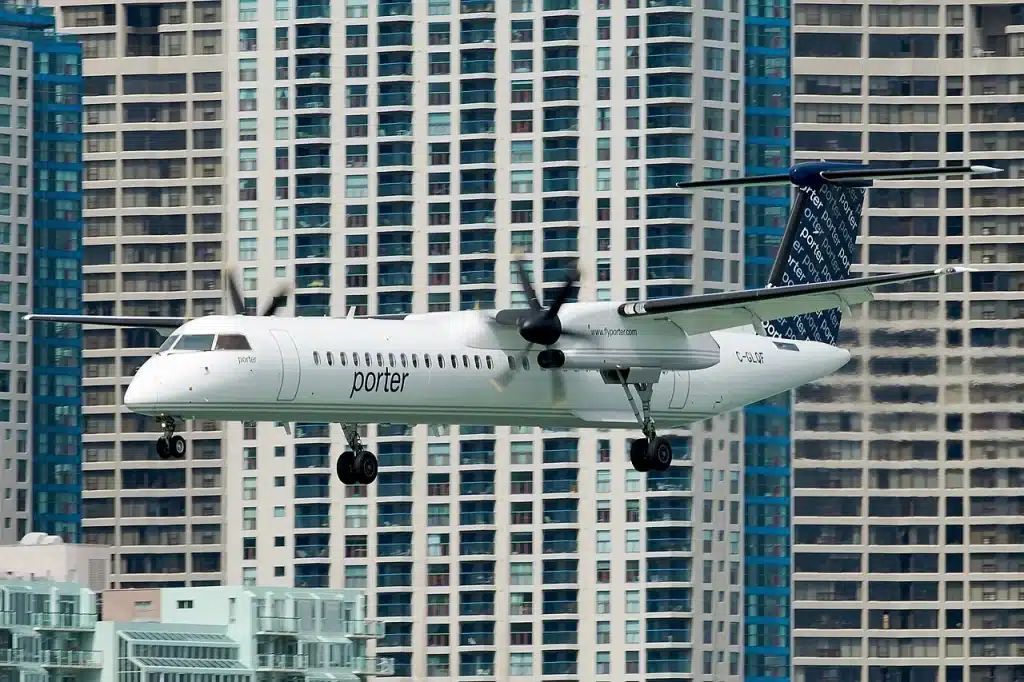
Porter was held back by its fleet. The same argument applies to Avelo. Porter’s growth ceiling was capped by their fleet of slow turboprops to make flying from Billy Bishop Airport possible.
Avelo relied heavily on older Next Generation Boeing 737s because they were cheap to acquire during the airline’s startup phase. But as Avelo’s operating costs show, those “cheap” planes became expensive to run, contributing to high operating costs.
The Embraer 195-E2’s fuel efficiency will reduce Avelo’s operating costs over time. Unlike Porter, Avelo won’t need to change airports to facilitate jet operations. Most of their current departure airports have runways long enough to support jets.
The E2 carries slightly fewer passengers than a Next Generation 737, but that works in Avelo’s favor. Operating from secondary airports with a smaller, more efficient plane like the Embraer 195-E2 should increase load factors, creating a more profitable operation overall.
If Avelo’s Embraer investment pays off and the airline begins to stabilize financially, they should consider revisiting the West Coast but with a different strategy.
Instead of establishing West Coast bases, why not operate transcontinental routes? Think New Haven to Burbank. Porter has proven this model works with the E2. Why wouldn’t it work for Avelo?
There’s even an opportunity for Avelo to relocate its main base from New Haven to Newburgh, New York. Stewart Airport offers longer runways and increased terminal capacity.
However, this only makes sense if the New York/New Jersey Port Authority steps up its efforts to facilitate demand at the airport.
Avelo won’t maximize the use of their fleet of potentially 100 Embraer 195-E2s by flying them exclusively on short routes to secondary destinations. The airline needs to spread its wings and branch out nationally and internationally, just as Porter has done.
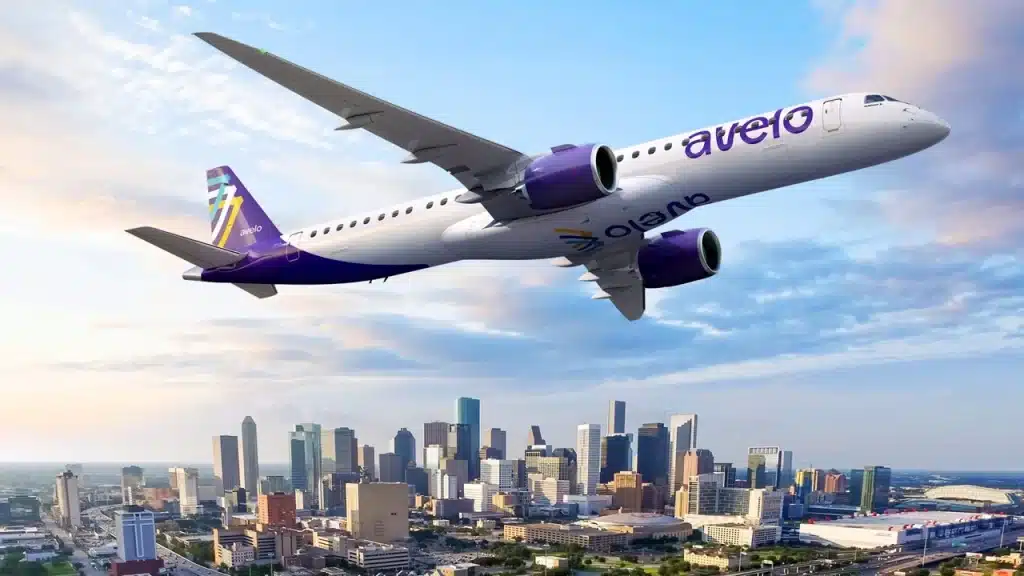
This section is purely speculative, as Avelo hasn’t released details about its E2 service. But here’s how the product rollout might unfold and what it could mean for customers.
Expect more space with the Embraer 195-E2 than on Avelo’s current fleet of Boeing 737s.
A 2×2 cabin configuration is almost guaranteed. That is already a significant improvement over Avelo’s current 3×3 high-density layouts. There’s simply no way to cram as many passengers into the E2 as Avelo and most ULCCs do with the 737 or equivalent aircraft.
Avelo needs to embrace this reality. With the number of planes they’re ordering combined with per-plane cost savings for operations, they should be able to offset lost revenue from reduced seating capacity.
| Airline | Aircraft | Seating Capacity |
| Avelo Airlines | Boeing 737-800 | 189 |
| Porter Airlines | Embraer 195 E2 | 132 |
Avelo will likely raise fees to maximize revenue per flight. The E2 is much smaller than the 737. Even though it may feature larger overhead bins for carry-ons (like Porter’s do), Avelo remains an ultra low cost airline that will nickel and dime passengers for any convenience. With fewer seats available per flight, this becomes even more necessary.
The E2 opens new possibilities for Avelo. The aircraft’s range and economics make longer routes both domestic transcontinental and international viable in ways the aging 737s never could. Expect to see Avelo expand beyond its current regional footprint once the fleet transition is complete.
If Porter’s playbook carries any weight for Avelo’s rollout, the ultra low cost carrier is on the cusp of a major transformation. Right now, Avelo’s biggest challenge is staying afloat until the new planes enter service. Avelo just needs to survive until 2027 for help to arrive.
Customers will benefit from Avelo’s E2 fleet. Service quality should improve through better cabin configurations and a likely expanded network.
However, the airline will almost certainly find new ways to generate fee revenue, with baggage and seat selection being the likely targets as storage and weight become more constrained on the smaller aircraft.
Porter made a complete 180-degree turn after adding the Embraer. The airline solved many of the same issues Avelo currently faces. Time will tell which path this investment takes for Avelo, but the precedent is promising. We’re eager to see how this story unfolds.