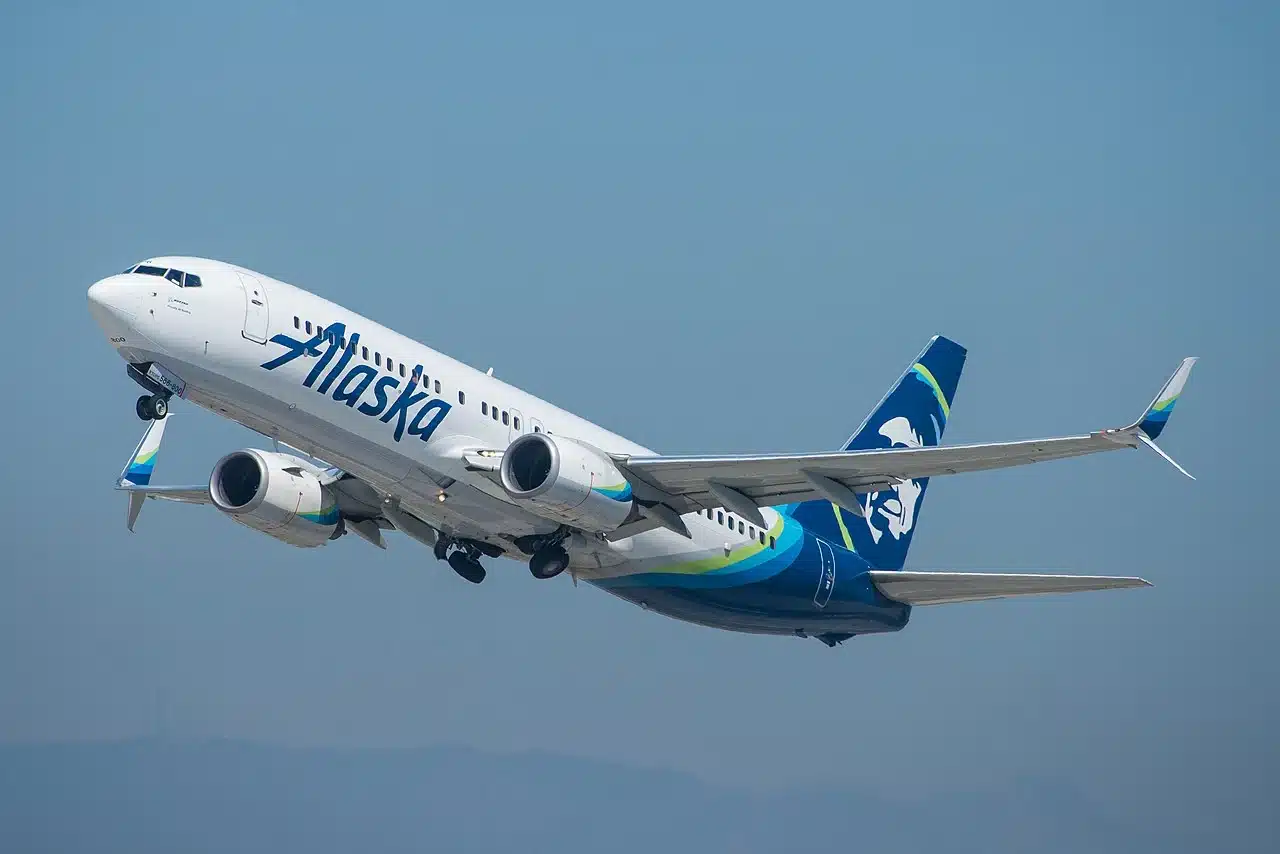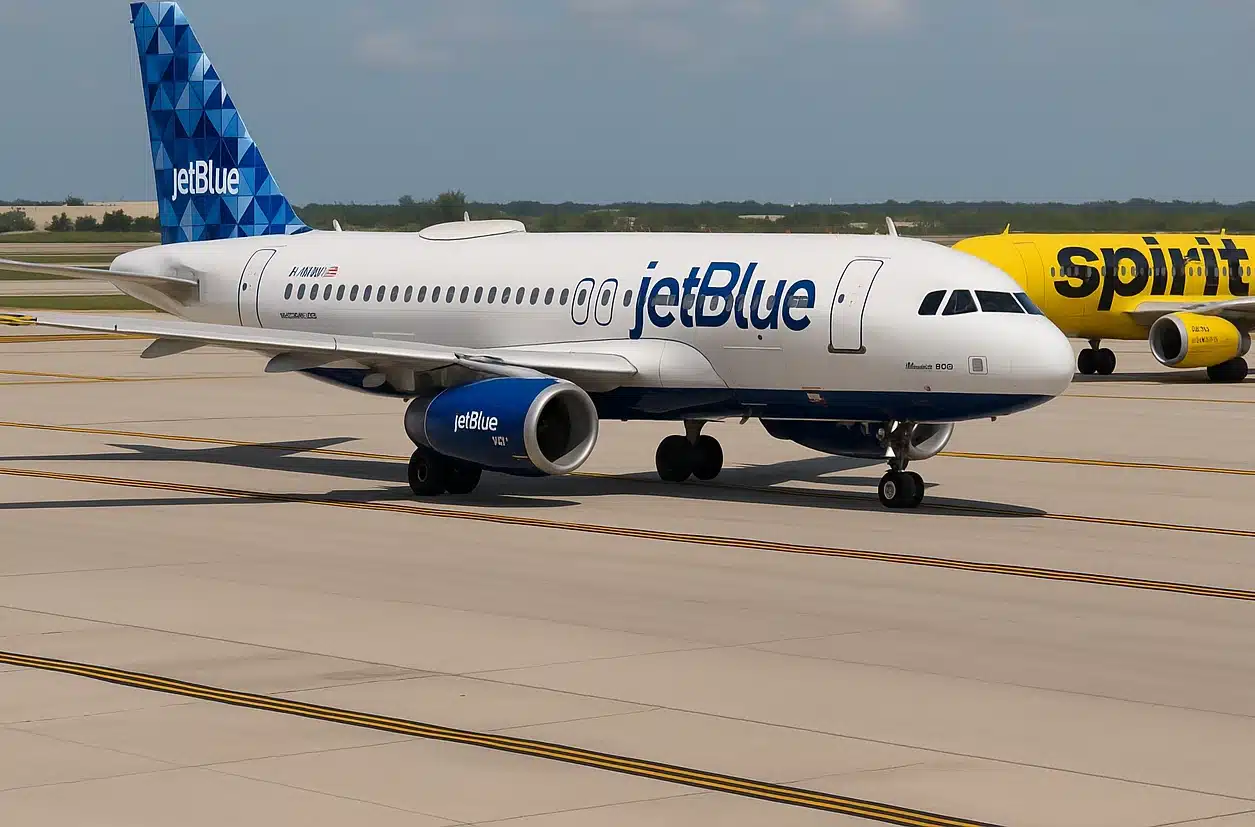
JetBlue & Spirit Target Florida with New Fort Lauderdale Routes
JetBlue adds new routes and Mint service in Fort Lauderdale, while Spirit launches Key West flights. See what’s changing for Florida flyers.

In March 2026, we had the opportunity to travel between New York to San Juan using JetBlue Airways. Find out what we thought of JetBlue’s economy product.
In March 2026, we had the opportunity to visit San Juan, Puerto Rico for five days. For this trip, we went with our preferred New York airline: JetBlue. It was my first time flying them post-pandemic, and I had some expectations to reassess. We flew flight B61003 southbound and B6904 on the return, both operated by JetBlue’s Airbus A320-200.
This review covers the full experience. We’ll cover the booking process, getting to the gate, boarding, in-flight amenities, and arrival. We’ll also give you our honest take on whether JetBlue is worth it over other options on this route.
We booked in mid-January 2026 through the JetBlue website. This flight was for myself and one other person.
One thing that caught us off guard was the pricing.JetBlue’s main cabin fares were noticeably higher than we expected. It wasn’t until after we booked that we realized we’d scheduled our trip during Spring Break. The reason I noticed was because JetBlue had the Airbus A220 assigned to this route on days prior to Thursday, March 12th. After that date, they swapped in the Airbus A320, which can handle significantly more capacity.
We ended up paying $446 total for two Economy (Blue) seats which isn’t bad for a nonstop flight during Spring Break week. However, deciding between Economy Core Blue and Economy Core Blue Extra was more difficult than it needed to be. The JetBlue website doesn’t do a great job of explaining the difference between the two sub tiers. But ultimately, the deciding factor was Blue Extra was significantly more expensive. We went with Blue and moved on.
We started our morning with an early LIRR train and took the AirTrain into JFK. Bag drop was straightforward. We’d checked in the night before via the JetBlue app and just needed to print a bag tag at the airport.
That said, JetBlue’s kiosk setup was a little confusing. There appeared to be two different kiosk hardware types side by side. One acknowledged you already had checked in and the other didn’t. We ended up using the one that already had your check in information and printed out our bag tags no problem.
The TSA checkpoint was a different story. Lines were long and the overall environment was chaotic. Agents were visibly frustrated, and several tense interactions played out in front of us as passengers arrived without boarding passes or enhanced ID ready.
It wasn’t a pleasant scene during these interactions, though it’s hard to place all the blame on staff given what they were dealing with. We got through without any issues and arrived at the gate with about an hour to spare.
Gate 524 sits on the northern side of JetBlue’s Terminal 5, right in the middle of their international operations. Our inbound aircraft, Airbus A320-200 “Out of The Blue,” tail number N510JB was arriving from an early morning flight out of West Palm Beach.
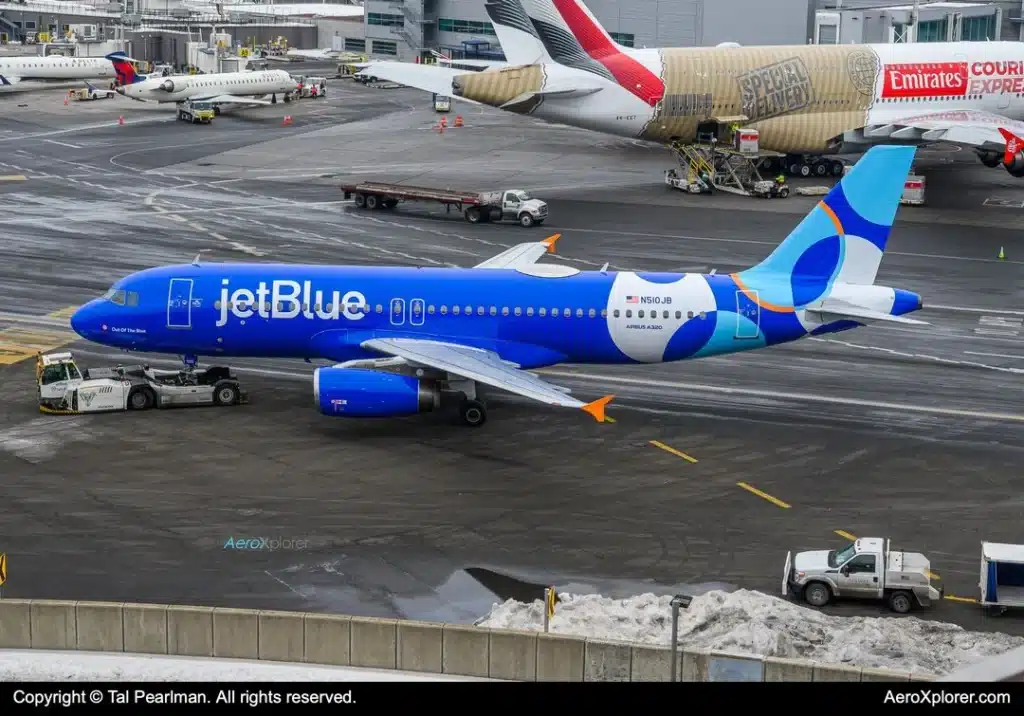
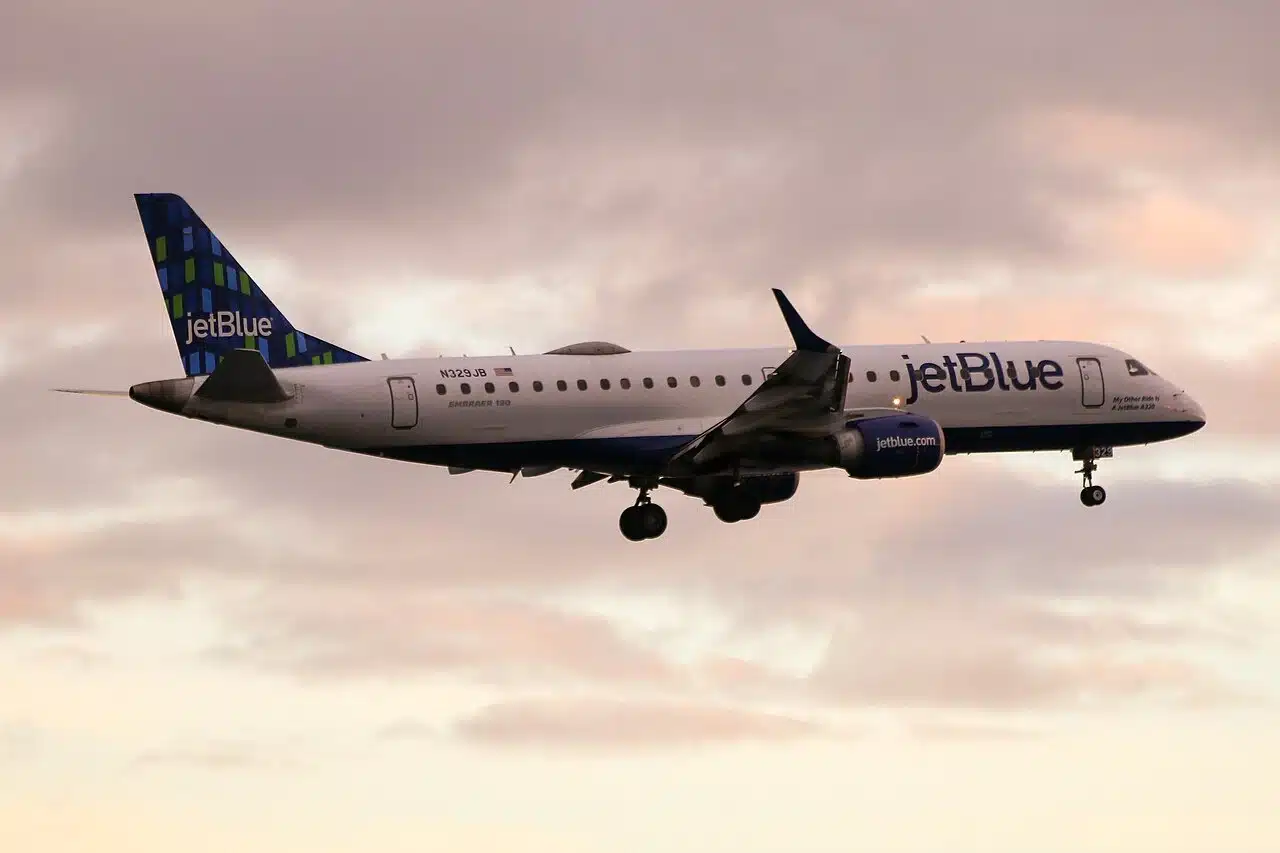
When it pulled in, I was pleasantly surprised to see it sporting JetBlue’s brand new livery. I fully expected an older A320 -200 to be wearing the legacy paint scheme, so that was a nice touch.
One observation worth noting: the gate next to ours was handling an international departure to St. Lucia. JetBlue uses a biometric boarding process for those flights, and it was clear that a number of passengers weren’t familiar with it. Gate agents were working hard to manage the confusion.
We were fortunate that Puerto Rico, as a U.S. territory, doesn’t require that process. That was because we didn’t print out our boarding passes. They were on my phone. How does one get past the biometric screening with both boarding passes on one phone? Do you just toss the phone back after you get screened? I’m sure that’s the easy solution, but you can see why boarding this way can cause log jams at the gate.
As for JetBlue’s Puerto Rico bound boarding experience, it was about as orderly a domestic boarding process as you’d expect, but not very efficient.
JetBlue uses a priority boarding system followed by zones A through F. In theory, it’s a clean process. In practice, a line formed almost immediately after priority was called, with passengers from every zone jumping in. Our zone was C. We made the call to wait at the very back of the line to skip the mass of people flooding the gate area. A decision we’d come to regret.
By the time we made it past the gate agent and went down the jetway, people with their bags were backing up on the bridge. The seemingly overwhelmed gate agents, communicating with the flight attendants, determined there was only enough overhead bin space left for the passenger directly ahead of us. Everyone behind, including us, had their carry-ons gate-checked. Not a dealbreaker but a clear indicator of just how packed this Spring Break flight was.
We were seated in row 21, seats A and B. The A320-200 was configured in a high-density, all-economy layout with JetBlue’s Even More Space seats limited to exit rows only. In other words, no one on this flight had a meaningfully elevated experience.
The seats were decent. JetBlue has long been known for offering some of the best legroom in economy amongst all U.S airlines, and that held true here. We had plenty of room to stretch out. That said, about halfway through the flight, the lack of seat cushioning started to make itself known. That’s a personal gripe, but worth mentioning.
This was the biggest disappointment of the trip. I still remember JetBlue’s IFE being a genuine differentiator. The airlines passed out complimentary headphones, had a solid content library, and provided an overall experience that felt a step above. That’s no longer the case, at least on this aircraft.
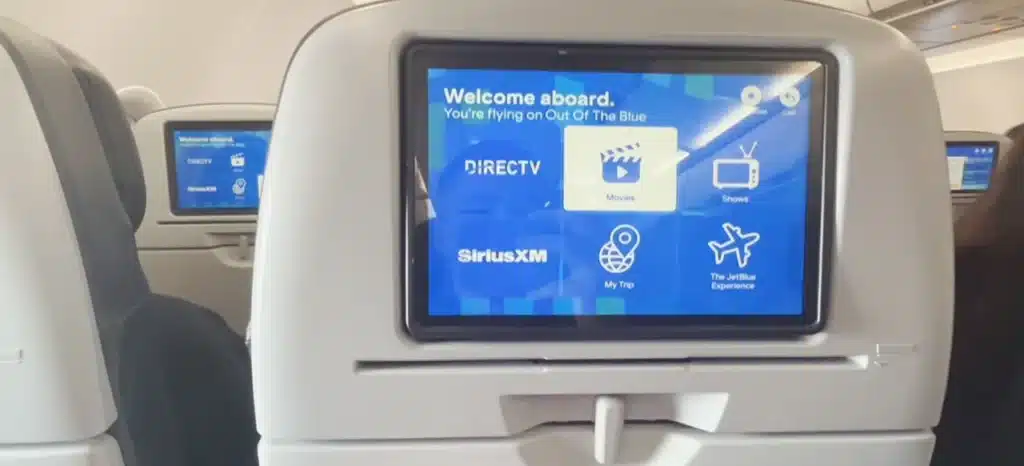
Our A320-200 had a relatively updated IFE system, but it still felt dated. The touchscreen was sluggish. Headphones were not complimentary. They were available for purchase at $7 a pair. To make matters worse, the system only supports wired headphones. If you didn’t bring your own wired pair, you were out of luck. Like I was.
There’s also a design quirk worth flagging: the IFE remote is embedded into the armrest. Use the armrest, and you risk accidentally changing the channel or adjusting the volume. It was a clever idea for its era, but it hasn’t aged well.
Nothing remarkable here, but nothing to complain about either. Flight attendants first came through with premium snack boxes, which had few takers on a leisure-heavy flight. Shortly after, the complimentary snack service followed. There were Plantain chips, Biscoff cookies, and Chewy Granola bars. Drinks included Pepsi products, water, and hot Dunkin’ coffee or tea. Perfectly fine for a short-haul flight of this nature.
We pushed back and made a quick taxi to Runway 13L. There was a sizable departure queue, but we weren’t held long. After takeoff, we completed a left turn following the Canarsie Climb departure procedure, climbed out over the Atlantic, and settled in at a cruise altitude of 35,000 feet.

The flight was largely uneventful. It was a straight shot south to San Juan with a few bumps near Bermuda and some additional turbulence on descent. The latter was enough for the captain to switch on the fasten seatbelt sign, though nothing alarming.
The arrival into San Juan featured a left turn to base and a straight-in approach to Luis Muñoz Marín International Airport’s Runway 10. The approach brought us parallel next to Old San Juan where we were staying offering a great view of the cruise ships lined up at port. We touched down without issue and taxied to Gate 5 at Concourse A.
The return flight a few days later was largely more of the same, with a few added complications. In the days leading up to our departure, videos of TSA lines wrapping around the block at SJU had gone viral, and JetBlue sent multiple emails urging passengers to arrive earlier than usual. When it was our turn, we got through in about an hour. Not painless, but manageable.
Flight JBU904 was initially delayed about 45 minutes, a combination of TSA staffing issues and weather rolling through the mainland. Then, once boarding was underway, a maintenance issue held us at the gate for another hour.
After that was resolved, ATC issued a revised routing to New York, which required the crew to update the Flight Management Computer adding further time on the ground. Frustrating, but all things considered, handled professionally.
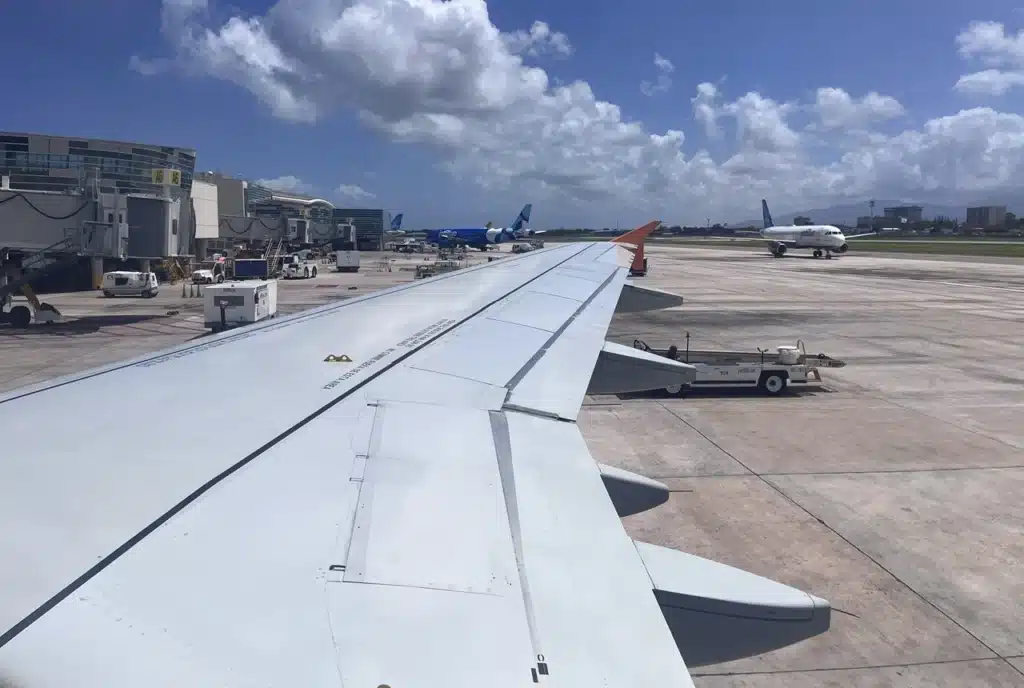
Once airborne, we encountered turbulence from Bermuda all the way to JFK due to the storm system passing through. The flight was otherwise uneventful.
One bright spot on the return: our aircraft, N608JB, had a noticeably better IFE system than the outbound plane, and the Wi-Fi was strong for virtually the entire flight. We didn’t have live TV as we were out of range the whole time but the improvement over N510JB was noticeable.
Did I get my money’s worth flying JetBlue? Yes. But it wasn’t the JetBlue I remembered.
So the real question: should you choose JetBlue over an ultra-low-cost carrier on the New York–Puerto Rico route?
If you’re flying out of New York, JetBlue is still the right call. At $446 for two seats during Spring Break week, the value holds up. The overall experience didn’t feel dramatically different from what you’d get on a ULCC. But with JetBlue, you do get in-flight entertainment, complimentary snacks, and more predictable service.
More importantly, JetBlue operates a significant number of nonstop flights between JFK and San Juan, with additional service from Boston Logan and Fort Lauderdale.
Avoiding a connection right now given the ongoing TSA situation is worth a premium on its own.
If you’re flying from anywhere else in the country, it’s worth pricing out the competition. Frontier in particular has a strong presence at SJU, as it serves as one of their crew bases. You’re not giving up much in terms of the onboard experience, and you may come out ahead on price.
JetBlue isn’t broken. But if you’re flying them expecting the experience that built their reputation, simmer those expectations a bit. They’re a solid option, just more based than they used to be.